
QuestionApril 13, 2026

50 points on a piece of paper answer the following prompt in 500 words. In California since 2016 a judge can charge juveniles as adults for certain violent crimes. The judge must consider multiple criteria, including the seriousness of the crime and its impact on the victim or the victim's family, the suspect's criminal history, and the suspect's past attempts at rehabilitation. This is a compromise between charging all juveniles who commit these violent crimes as adults and never charging juveniles as adults regardless of the type of crime they commit. Considering all the arguments that you have read and discussed during this module, write a thoughtful and well-documented open letter to be published on a Web site for those interested in the issue of juvenile crime, particularly state policymakers. In your open letter, explain your viewpoint about sentencing juveniles who commit serious crimes and provide evidence that supports your position. Respond to the arguments of those who have different perspectives. Be sure to respond to all the different major arguments that you have read. Make clear whose ideas or words you are using by including author names and titles, but an require in- text citations (page numbers)or a reference list.
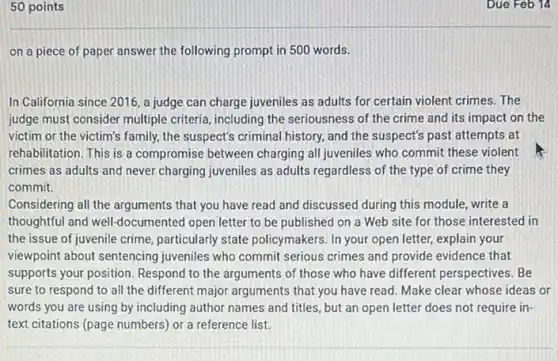
50 points on a piece of paper answer the following prompt in 500 words. In California since 2016 a judge can charge juveniles as adults for certain violent crimes. The judge must consider multiple criteria, including the seriousness of the crime and its impact on the victim or the victim's family, the suspect's criminal history, and the suspect's past attempts at rehabilitation. This is a compromise between charging all juveniles who commit these violent crimes as adults and never charging juveniles as adults regardless of the type of crime they commit. Considering all the arguments that you have read and discussed during this module, write a thoughtful and well-documented open letter to be published on a Web site for those interested in the issue of juvenile crime, particularly state policymakers. In your open letter, explain your viewpoint about sentencing juveniles who commit serious crimes and provide evidence that supports your position. Respond to the arguments of those who have different perspectives. Be sure to respond to all the different major arguments that you have read. Make clear whose ideas or words you are using by including author names and titles, but an require in- text citations (page numbers)or a reference list.
50 points
on a piece of paper answer the following prompt in 500 words.
In California since 2016 a judge can charge juveniles as adults for certain violent crimes. The
judge must consider multiple criteria, including the seriousness of the crime and its impact on the
victim or the victim's family, the suspect's criminal history, and the suspect's past attempts at
rehabilitation. This is a compromise between charging all juveniles who commit these violent
crimes as adults and never charging juveniles as adults regardless of the type of crime they
commit.
Considering all the arguments that you have read and discussed during this module, write a
thoughtful and well-documented open letter to be published on a Web site for those interested in
the issue of juvenile crime, particularly state policymakers. In your open letter, explain your
viewpoint about sentencing juveniles who commit serious crimes and provide evidence that
supports your position. Respond to the arguments of those who have different perspectives. Be
sure to respond to all the different major arguments that you have read. Make clear whose ideas or
words you are using by including author names and titles, but an require in-
text citations (page numbers)or a reference list.

Solution
3.7(156 votes)

Answer

**Open Letter to State Policymakers on Juvenile Sentencing** Dear State Policymakers, The question of whether juveniles who commit serious crimes should be sentenced as adults is a deeply complex and contentious issue. As policymakers, you hold the responsibility of balancing justice, public safety, and the potential for rehabilitation. I write to you today to advocate for a nuanced approach that prioritizes rehabilitation over punitive measures while ensuring accountability for serious offenses. Juveniles differ fundamentally from adults in their cognitive and emotional development. Neuroscientific research, such as that conducted by the National Institute of Mental Health, demonstrates that the adolescent brain, particularly the prefrontal cortex responsible for decision-making and impulse control, is not fully developed until the mid-20s. This developmental reality underscores the argument that juveniles are less culpable than adults and more amenable to rehabilitation. Sentencing juveniles as adults disregards these scientific findings and risks perpetuating cycles of criminal behavior rather than breaking them. Critics of leniency argue that the seriousness of certain crimes necessitates adult sentencing to ensure justice for victims and deter future offenses. While the gravity of violent crimes cannot be understated, it is essential to recognize that harsh sentencing does not necessarily equate to justice. Studies have shown that juveniles tried as adults are more likely to reoffend upon release, as they are exposed to hardened criminals in adult facilities and denied access to rehabilitative programs tailored to their developmental needs. True justice should aim not only to punish but also to prevent future harm, a goal better achieved through juvenile justice systems focused on rehabilitation. Furthermore, the impact of adult sentencing on juveniles extends beyond the individual to society at large. Juveniles sentenced as adults often face lifelong barriers to education, employment, and social reintegration, increasing the likelihood of recidivism and perpetuating cycles of poverty and crime. By investing in rehabilitation programs that address the root causes of criminal behavior—such as trauma, substance abuse, and lack of education—we can reduce recidivism rates and foster productive, law-abiding citizens. Some argue that a blanket policy of leniency could undermine public safety and fail to hold juveniles accountable for their actions. However, the current system in California, which allows judges to consider multiple criteria such as the seriousness of the crime, the suspect's criminal history, and past attempts at rehabilitation, strikes a reasonable balance. This approach ensures that each case is evaluated on its merits, allowing for accountability in severe cases while preserving the possibility of rehabilitation for those who demonstrate potential for reform. In conclusion, I urge you to continue refining policies that emphasize rehabilitation over retribution for juveniles who commit serious crimes. By considering the developmental differences of juveniles, the societal costs of adult sentencing, and the potential for rehabilitation, we can create a justice system that is both fair and effective. Let us not lose sight of the fact that juveniles, despite their mistakes, are still children with the capacity for change. A justice system that recognizes this truth is one that truly serves its citizens. Sincerely, [Your Name] Explanation This problem falls under the discipline of Social Science, specifically the subfield of Law, as it pertains to legal policies and ethical considerations regarding juvenile sentencing. The task requires crafting an open letter that articulates a viewpoint on sentencing juveniles who commit serious crimes, addressing multiple perspectives and providing evidence-based arguments. The solution involves analyzing the ethical, legal, and social dimensions of the issue while responding to counterarguments.

Explanation

This problem falls under the discipline of Social Science, specifically the subfield of Law, as it pertains to legal policies and ethical considerations regarding juvenile sentencing. The task requires crafting an open letter that articulates a viewpoint on sentencing juveniles who commit serious crimes, addressing multiple perspectives and providing evidence-based arguments. The solution involves analyzing the ethical, legal, and social dimensions of the issue while responding to counterarguments.
Click to rate:

Similar Questions