


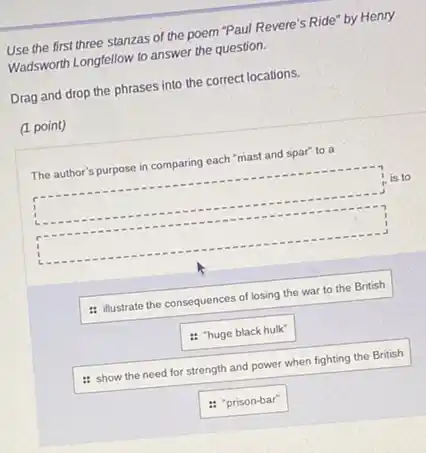
Use the first three stanzas of the poem "Paul Revere's Ride" by Henry Wadsworth Longfellow to answer the question. Drag and drop the phrases into the correct locations. (1 point) The author's purpose in comparing each "mast and spar" to a square is to square : illustrate the consequences of losing the war to the British : "huge black hulk" : show the need for strength and power when fighting the British : "prison-bar"
Solution4.1(295 votes)
Answer
Explanation
Similar Questions
Question 5 of 10, Step 1 of1 Consider the following scenario: Isaac is writing a body paragraph for a paper about the American Revolution. Based on this information what is a characteristic of his paragraph? Select the best answer. Answer It restates the thesis of his text. It has signpost words that connect his ideas. It ends with his paper's purpose statement. It might end with a real-world application.
Yo-Yo Ma's The Soul of the Tango won a Pulitzer and contributed to the elevation of tango from its humble roots. 1) True ) 2) False
Question 5 (2.5 points) The introductory paragraph __ directs the reader outward and onward opens your essay and gives focus to your work presents all your evidence develops your thesis
Shaw's Partita inspired discussion about whether it had the necessary characteristics to satisfy the criteria used to evaluate compositional quality. 1) True 2) False
DAMN. was a revolutionary choice for the Pulitzer Prize because: 1) It was a hip-hop album 2) It did not begin as notes on a page 3) It was not a traditional example of art music 4) It derived from a popular genre 5) All of the above 6) None of the above
4. Who is sent to talk with Calypso about releasing Odysseus? __ to release Odysseus? What was the reason given? __ __ 6. Calypso thinks all the Gods are what? __ 7. What must Odysseus do in order to leave the island? How long does it take him to make? __ __ __ 8. Why is he trying to reach land? __ 9. How long does Odysseus travel after he leaves Calypso's island? __ 10. Describe what happens to him during his travel. Be specific with details. __ __
Yo-Yo Ma's most significant and lasting foray outside of the European concert tradition is: 1) East Indies Project 2) Silk and Spice Route Project 3) Incense Route Project 4) Silk Road Project 5) All of the above 6) None of the above
8. How is the information in paragraphs $3-6$ organized? A. by comparing events in the past and events today B. by describing events in the order in which they occurred C. by explaining the historical events that led to segregation D. by introducing many historical figures of the civil rights movement
Character Analysis Choose a character from the novel 1984 by George Orwell and write a character analysis. Discuss their motivations relationships, and changes throughout these chapters.
Select all that apply The following can be inferred about a character from a character's costume. ability to be successful high or low status specific occupation personality traits age of the character