


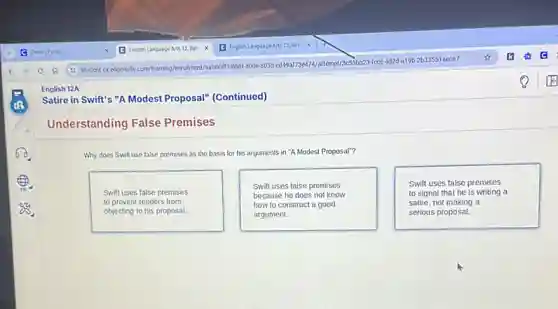
Satire in Swift's "A Modest Proposal" (Continued) Understanding False Premises Why does Swift use false premises as the basis for his arguments in "A Modest Proposal"? Swift uses false premises to prevent readers from objecting to his proposal. Swift uses false premises because he does not know how to construct a good argument. Swift uses false premises to signal that he is writing a satire, not making a serious proposal.
Solution4.3(280 votes)
Answer
Explanation
Similar Questions
What characteristic of Romanticism is the cause of the rift between King Arthur and Sir Lancelot? Courage-King-Arthur was jealous of Sir Lancelot's great courage. Honesty-Lanceiot tells the truth to Sir Mordred linstead of to King Arthur. Gallant love: Sir Lancelot loves Guinevere, King Arthur'wife
In Before the Rain there is a repeated motif of the phrase Time Never Dies, the Circle is Not Round. There is NO version of this motif spoken or written in Part 02 Faces (the London section with Anne at the photo agency and Aleksander). No / False Yes / True
Which one of August Strindberg's plays would be considered part of the Symbolism period? "The Ghost Sonata" "The Father" "Miss Julie"
Determine where the quotation marks should be in the following sentence. Why didn't you pick me?he asked indignantly. Why "didn't you pick me"?he asked indignantly. "Why didn't you pick me?" he asked indignantly. "Why didn't you pick me?he asked indignantly?"
Who discovers that the king has been murdered? Macduff Lady Macbeth Malcolm Banquo
One way Before the Rain has a circular narrative structure is that the viewer sees __ near both the beginning and the end section of the film. Zamira running towards a monastery. Alexsander dying from a gunshot wound. Anne inside the monastery. Kiril in a vegetable garden.
Question 2 of.25 Which story idea best fits the traditional definition of tragedy? A. A student with bad luck finds herself in one awful situation after another. B. A pirate captain loses her ship and her life in her manic pursuit of plunder. C. A wizard summons a powerful creature but finds that he can't control it. D. A duelist challenges her greatest rival to a sword fight, but she is defeated.
Complete the sentence so that it uses personification. The long-lgnored book sat __ on the nightstand. patiently unread
Determine where the quotation marks should be in the following sentence. You're doing great! the teacher remarked. You're doing great! "the teacher remarked." You're "doing great!" the teacher remarked. "You're doing great!" the teacher remarked.
Why doesn't Hamlet feel guilty about sending Rosencrantz and Guildenstern to their deaths? He thinks that killing them is the best way to get revenge for his father's death. He thinks that they are to blame for the fact that he is not king. He thinks that they would have challenged him to a swordight and he would have lost. He thinks that they brought punishment on themselves by worming their way Into Hamlet's business.