


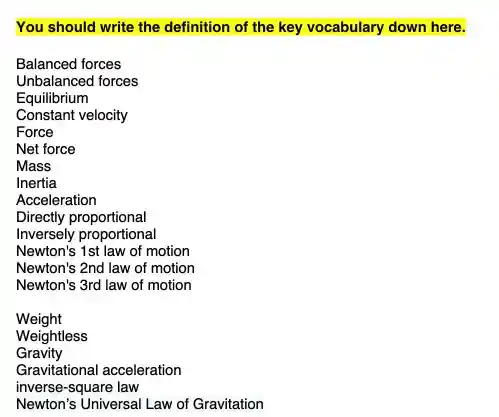
You should write the definition of the key vocabulary down here. Balanced forces Unbalanced forces Equilibrium Constant velocity Force Net force Mass Inertia Acceleration Directly proportional Inversely proportional Newton's 1st law of motion Newton's 2nd law of motion Newton's 3rd law of motion Weight
Solution3.1(342 votes)
Answer
Similar Questions
Which statement about temperature is correct? Temperature can measure the kinetic energy between two objects. Temperature can measure the heat movement between two objects. Temperature can measure the potential energy between two objects. Temperature can measure the mass transfer between two objects.
Reasoning:Explain how energy is transferred through the water.
What happens to an object when it absorbs light? A. It gets colder B. It gets warmer C. It changes material D. It becomes transparent
What happens to the total momentum of two objects after a collision? It remains the same It decreases It becomes zero It increases
14. What is the net force acting upon an object which is subjected to the following forces? 3 Newtons South 3 Newtons North 5 Newtons East 7 Newtons West 2 Newtons West 18 Newtons North 6 Newtons West 18 Newtons South
18. A force $F(x)=10x(inN)$ acts over a displacement from $x=0$ to $x=3$ m. What is the work done?
17. How much power is exerted when you lift a 60-kg rock to a height of 25 m in 30 seconds?
A 60 kg sprinter is running at a velocity of $8m/s$ during a race Calculate the sprinter's kinetic energy. 240J 480 J 3,480J 1,920 J
When using a megger to check insulation resistance to ground, which of the following would be an acceptable minimum resistance? a. $1K\Omega $ b. $5K\Omega $ c. $1M\Omega $ d. $25\Omega $
Question 24 lyana is studying how distance affects gravitational forces She studies a chart of the distance of the planets from the Sun n and the force of the Sun's gravity on them. What would you expect the chart to indicate? The force of the Sun's gravity is stronger on the more distant planets. The force of the Sun's gravity is equal on all the planets. The force of the Sun's gravity depends only on mass distance has no effect. The force of the Sun's gravity weaker on the more distant planets.