


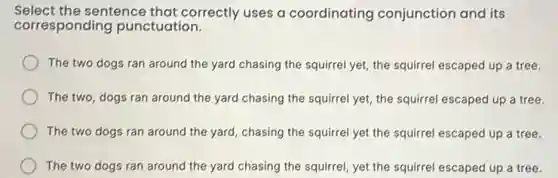
Select the sentence that correctly uses a coordinating conjunction and its corresponding punctuation. The two dogs ran around the yard chasing the squirrel yet, the squirrel escaped up a tree. The two, dogs ran around the yard chasing the squirrel yet, the squirrel escaped up a tree. The two dogs ran around the yard, chasing the squirrel yet the squirrel escaped up a tree. The two dogs ran around the yard chasing the squirrel, yet the squirrel escaped up a tree.
Solution4.4(270 votes)
Answer
Explanation
Similar Questions
Vivid language captures people's attention and their imagination by conveying emotions and action. True False
The 8-beat cycle in this example is known as: 1. raga 2. adi-tala 3. drone 4. kriti 1 2 3 4
What is the meaning of aesthetic impact? (1 point) Feelings relating to the senses. The way a story is organized and presented. The author's attitude toward the subject matter. A lesson or message in an artistic work.
Which word best matches the denotative meaning of "quarry" as used in the passage? A. Treasure B. Weapon C. Shelter D. Prey
Multiple Choice Two pitches played together form a (1 point) triad. chord. melodic interval. harmonic interval.
Which of the nouns in this sentence are plural? Skyscrapers dominated the skyline. Choose all answers that apply: A skyscrapers A B skyline B
If you are signing 68, you twist to the right if right-handed and to the left if left-handed. (1 point) True False
Is this a run-on sentence? When a dog wags Its tail, it doesn't always mean the dog is happy or friendly,a wag that is slow and restrained may convey a warning to "back off." yes no
Which sentence is grammatically correct? I runned to the basketball game when the track coach saw me. I running to the basketball game when the track coach saw me. I was running to the basketball game when the track coach saw me. I am running to the basketball game when the track coach saw me.
Form a compound sentence. were dying out, but they have made a comeback once thrived in enormous colonies along North American coasts nearly died out in the eastern United States