


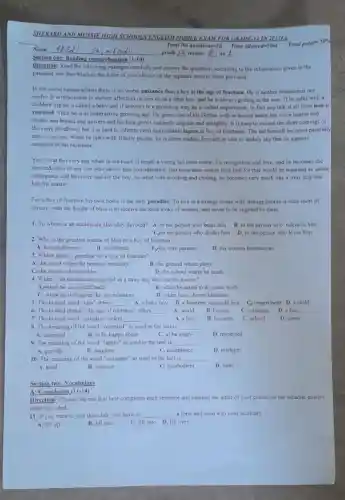
SHERARO AND MUSSIE HIGH SCHOOLS ENGLE II MODEL EXAM FOR GRADE 12 IN 201265 Section one: Reading comprehension (1-10) Direction: Read the following passages carefully and answer the questions according to the information given in the passages and then blacken the letter of your choice on the separate answer sheet provided. In the world human affairs there is no worse nuisance than a boy at the age of fourteen.He is neither omamental nor useful. It is impossible to shower affection on him as on a little boy; and he is always getting in the way. If he talks with a childish lisp he is called a baby and if answers in a grown up way he is called impertinent. In fact any talk at all from him is resented. Then he is at unattractive growing age.He grows out of his clothes with in docent haste; his voice hoarse and breaks and breaks and quivers and his face grows suddenly angular and unsightly. It is easy to excuse the short comings of the carly childhood, but it is hard to tolerate even unavoidable lapses in boy of fourteens The lad himself becomes painfully self-conscious. When he talks with elderly people, he is cither unduly form ard or else so unduly shy that he appears ashamed of his existence Yet it is at this very age when in his heart of hearts a young lad most craves for recognition and love; and he becomes the devoted slave of any one who shows him consideration But none dare openly love him for that would be regarded as undue indulgence and therefore bad for the boy. So what with scolding and chiding, he becomes very much like a stray dog that lost his master. For a boy of fourteen his own home is the only paradise To live in a strange house with strange people is little short of torture, with the height of bliss is to receive the kind looks of women, and never to be slighted by them 1. To whom is an adolescent slavishly devoted?A, to the person who beats him B, to the person who tolerates him C.to the person who chides him D, to the person who loves him 2. Who is the greatest source of bliss to a boy of fourteen? A, his neighbours B, his friends Chis own parents D. his women benefactors 3. Which place a paradise for a boy of fourteen? A, the street where he practice mischief B. the ground where plays C/the house where resides D. the school where he reads 4. When is an adolescent regarded as a stray dog that lost his master? A.when he is scolded badly B. when he asked to do some work C, when he is forgiven for his mistakes D, when he is shown kindness 5. The bolded word "him"refers __ A. a baby boy B, a fourteen years old boy C) impertinent D, a child 6. The bolded phrase "the age of fourteen"refers __ A. world B. human C, nuisance D, a boy 7. The bolded word "paradise" refers __ A, a boy B. fourteen C, school D. home 8. The meaning of the word "resented" as used in the text is __ A. accepted B, to be happy about C, to be angry D. respected 9. The meaning of the word "lapses" as used in the text is __ A. growth B. laughter C, acceptance D. mistakes 10. The meaning of the word "nuisance" as used in the text is __ A. kind B. humour C, disobedient D. baby Section two: Vocabulary A: Completion (11-14) Direction: Choose the one that best completes each sentence and blacken the letter of your choice on the separate answer sheet provided. 11. If you want to join that club, you have to __ a form and send it to your secretary A. fill up B. fill out C.fill into D,fill over
Solution4.6(339 votes)
Answer
Explanation
Similar Questions
Which is one way that Swift criticizes society in"A Modest Proposal"? by suggesting that people care so little about children they would be willing to sell and eat them by highlighting the ways in which the plan could help people support people's families by highlighting all the practical ways in which people have tried to remedy poverty
Which statement is a theme? The story teaches the importance of devoted friends Gilgamesh delivers an encouraging speech to Enkidu. When Humbaba is defeated, the friends rejoice. True friends remain loyal despite hardship.
To compare characters effectively.a reader should notice their internal influences. outside influences. attitudes toward things. similarities and differences.
What figurative language is used in 'The bacon sizzled in the pan'? Alliteration Assonance Personification Onomatopoeia
Which figurative language is used in He was a real Romeo with the ladies'? Metaphor Allusion Personification Hyperbole
What is the source of the allusion in the sentence below? Louanne's Ice Cream Parlor has the best dessert short of ambrosial the Bible Greek mythology
The Black poet Langston Hughes was a prominent figure of the Harlem Renaissance. The Black musician Louis Armstrong was a prominent figure of the Harlem Renaissance. Combine the sentences into one sentence. Type your answer here.
Identify the figurative language in 'She sells sea shells by the sea shore. Alliteratics Assonance Onomatopoeia Oxymoron
Explain how Antigone and Macbeth respond differently when faced with conflict.
What was a major goal of the use of satire in Enlightenment art and literature?. (1 point) To accept traditional ideas as they are without question To show the upper class of society in a better light To use humor and exaggeration to point out societal and cultural issues. To demonstrate the good in the culture and society of that era.