
QuestionDecember 29, 2025

RECTIONS: Read the lesson in your Student Edition and fill in the blanks to complete the outline. Nationalist Revolts A. Napoleon's defeat of Spain and Portugal created an opportunity for elite __ who resented the peninsulares ,to bring about change in Latin America. B. Hispaniola, later named Hait,achieved __ when, in 1804, revolutionaries took control of the western part of the island after a thirteen-year struggle.making Haiti the first country in the world to abolish __ C. The revolution in Haiti was led by François-Dominique __ who was captured by the __ and died in prison less than a year before independence was won. D. In 1810, Miguel __ y Costilla, a Catholic priest, led an unsuccessful peasant revolt. However, it was successful in inspiring the creoles and peninsulores to work together to overthrow Spain, and Mexico became an independent nation in the year __ E. By1830,nearly every country in Central and South America had achieved independence, largely due to the efforts of two members of the creole elite: __ , who was from Argentina, and __ who was from Venezuela. F. Although much of Europe favored sending troops to help restore Spain's power in Latin America,the __ did not because they wanted to trade with Latin America. G. The United States also favored keeping Europe out of Latin America, and the __ of 1823 declared that the Americas were off limits to colonization. Nation Building A. Although most of the new nations in Latin America began as republics strong leaders known as __ soon gained control and ruled primarily through military force and support from the landed elites. B. Largely because of the chaotic rule of Antonio López de __ , Mexican Texas gained independence from Mexico in the year __ C. Most of the social, political, and economic power in the new Latin American nations remained in the hands of elites who owned most of the __ , which they often used to grow __ , leaving most of the population to live in poverty without enough food. D. Although Latin American countries had gained political independence, their economies were dominated by exporting __ materials and agricultural products and importing __ products, causing an economic dependence on industrialized nations that was similar to colonialism.
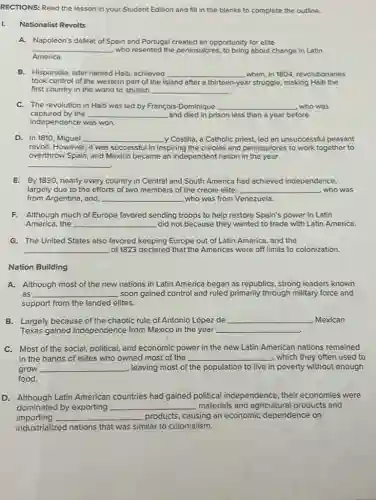
RECTIONS: Read the lesson in your Student Edition and fill in the blanks to complete the outline. Nationalist Revolts A. Napoleon's defeat of Spain and Portugal created an opportunity for elite __ who resented the peninsulares ,to bring about change in Latin America. B. Hispaniola, later named Hait,achieved __ when, in 1804, revolutionaries took control of the western part of the island after a thirteen-year struggle.making Haiti the first country in the world to abolish __ C. The revolution in Haiti was led by François-Dominique __ who was captured by the __ and died in prison less than a year before independence was won. D. In 1810, Miguel __ y Costilla, a Catholic priest, led an unsuccessful peasant revolt. However, it was successful in inspiring the creoles and peninsulores to work together to overthrow Spain, and Mexico became an independent nation in the year __ E. By1830,nearly every country in Central and South America had achieved independence, largely due to the efforts of two members of the creole elite: __ , who was from Argentina, and __ who was from Venezuela. F. Although much of Europe favored sending troops to help restore Spain's power in Latin America,the __ did not because they wanted to trade with Latin America. G. The United States also favored keeping Europe out of Latin America, and the __ of 1823 declared that the Americas were off limits to colonization. Nation Building A. Although most of the new nations in Latin America began as republics strong leaders known as __ soon gained control and ruled primarily through military force and support from the landed elites. B. Largely because of the chaotic rule of Antonio López de __ , Mexican Texas gained independence from Mexico in the year __ C. Most of the social, political, and economic power in the new Latin American nations remained in the hands of elites who owned most of the __ , which they often used to grow __ , leaving most of the population to live in poverty without enough food. D. Although Latin American countries had gained political independence, their economies were dominated by exporting __ materials and agricultural products and importing __ products, causing an economic dependence on industrialized nations that was similar to colonialism.
RECTIONS: Read the lesson in your Student Edition and fill in the blanks to complete the outline.
Nationalist Revolts
A. Napoleon's defeat of Spain and Portugal created an opportunity for elite
__ who resented the peninsulares ,to bring about change in Latin
America.
B. Hispaniola, later named Hait,achieved __ when, in 1804, revolutionaries
took control of the western part of the island after a thirteen-year struggle.making Haiti the
first country in the world to abolish __
C. The revolution in Haiti was led by François-Dominique __ who was
captured by the __ and died in prison less than a year before
independence was won.
D. In 1810, Miguel __ y Costilla, a Catholic priest, led an unsuccessful peasant
revolt. However, it was successful in inspiring the creoles and peninsulores to work together to
overthrow Spain, and Mexico became an independent nation in the year
__
E. By1830,nearly every country in Central and South America had achieved independence,
largely due to the efforts of two members of the creole elite: __ , who was
from Argentina, and __ who was from Venezuela.
F. Although much of Europe favored sending troops to help restore Spain's power in Latin
America,the __ did not because they wanted to trade with Latin America.
G. The United States also favored keeping Europe out of Latin America, and the
__ of 1823 declared that the Americas were off limits to colonization.
Nation Building
A. Although most of the new nations in Latin America began as republics strong leaders known
as __ soon gained control and ruled primarily through military force and
support from the landed elites.
B. Largely because of the chaotic rule of Antonio López de __ , Mexican
Texas gained independence from Mexico in the year __
C. Most of the social, political, and economic power in the new Latin American nations remained
in the hands of elites who owned most of the __ , which they often used to
grow __ , leaving most of the population to live in poverty without enough
food.
D. Although Latin American countries had gained political independence, their economies were
dominated by exporting __ materials and agricultural products and
importing __ products, causing an economic dependence on
industrialized nations that was similar to colonialism.

Solution
3.5(321 votes)

Answer

Nationalist Revolts A. Napoleon's defeat of Spain and Portugal created an opportunity for elite **creoles** who resented the peninsulares, to bring about change in Latin America. B. Hispaniola, later named Haiti, achieved **independence** when, in 1804, revolutionaries took control of the western part of the island after a thirteen-year struggle, making Haiti the first country in the world to abolish **slavery**. C. The revolution in Haiti was led by François-Dominique **Toussaint Louverture**, who was captured by the **French** and died in prison less than a year before independence was won. D. In 1810, Miguel **Hidalgo** y Costilla, a Catholic priest, led an unsuccessful peasant revolt. However, it was successful in inspiring the creoles and peninsulares to work together to overthrow Spain, and Mexico became an independent nation in the year **1821**. E. By 1830, nearly every country in Central and South America had achieved independence, largely due to the efforts of two members of the creole elite: **José de San Martín**, who was from Argentina, and **Simón Bolívar**, who was from Venezuela. F. Although much of Europe favored sending troops to help restore Spain's power in Latin America, the **British** did not because they wanted to trade with Latin America. G. The United States also favored keeping Europe out of Latin America, and the **Monroe Doctrine** of 1823 declared that the Americas were off limits to colonization. Nation Building A. Although most of the new nations in Latin America began as republics, strong leaders known as **caudillos** soon gained control and ruled primarily through military force and support from the landed elites. B. Largely because of the chaotic rule of Antonio López de **Santa Anna**, Mexican Texas gained independence from Mexico in the year **1836**. C. Most of the social, political, and economic power in the new Latin American nations remained in the hands of elites who owned most of the **land**, which they often used to grow **cash crops**, leaving most of the population to live in poverty without enough food. D. Although Latin American countries had gained political independence, their economies were dominated by exporting **raw** materials and agricultural products and importing **manufactured** products, causing an economic dependence on industrialized nations that was similar to colonialism. Explanation This problem involves filling in the blanks with historical facts related to nationalist revolts and nation-building in Latin America. The answers are based on key events and figures from the early 19th century, particularly focusing on the independence movements and the subsequent political and economic developments in the region.

Explanation

This problem involves filling in the blanks with historical facts related to nationalist revolts and nation-building in Latin America. The answers are based on key events and figures from the early 19th century, particularly focusing on the independence movements and the subsequent political and economic developments in the region.
Click to rate:

Similar Questions