


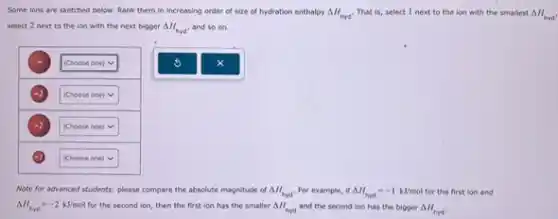
Some ions are sketched below. Rank them in increasing order of size of hydration enthalpy Delta H_(myd) That is, select I next to the ion with the smallest Delta H_(hrd') select 2 next to the ion with the next bigger Delta H_(hyd') and so on. (-) [Choose one) V (Choose one) V square . square Note for advanced students:please compare the absolute magnitude of Delta H_(hyd). For example, if Delta H_(hyd)=-1kJ/mol for the first lon and Delta H_(hyd)=-2kJ/mol for the second ion, then the first ion has the smaller Delta H_(hyd) and the second lion has the bigger Delta H_(myd).
Solution4.7(157 votes)
Answer
Explanation
Similar Questions
Select the correct answer and then click the Next button. Which of the following is evidence of corrosion? a. Cracking, flaking, or chalking b. Smooth outer surface c. Solid-colored coating paint d. Multi-colored coating paint
You have a balloon containing 1 L of air at STP in a vacuum chamber. What will the volume of the balloon be when you reduce the pressure by half and increase the temperature to 373 K? Use the combined gas law $PV/T=korP_{1}V_{1}/T_{1}=P_{2}V_{2}/T_{2}$ 0.68 L 1.46 L 2.00 L 2.73 L
3. How many moles is $2.80\times 10^{24}$ atoms of silicon?
Which process removes impurities in water most easily? distillation magnetism fractionation chromatography
Which of the following is an example of a chemical change? Color How it looks How it smells How it feels
Partial pressure is the pressure exerted by __ within a mixture of gases. each ges all gases Need help? Review these concept resources.
b. How many particles of $NaClO_{3}$ are needed to produce 68.30 g oxygen? $\underline {\quad }X\underline {\quad }X\underline {\quad }X\underline {\quad }$
Describe the conductivity of the weak acid. The weak acid does show signs of conductivity and slightly illuminates the light. The weak acid does not show signs of conductivity and does not illuminate the light bult.
Which of the following is a balanced equation for the reaction between silver nitrate and copper? A. $AgNO_{3}+2Cu\rightarrow 2Cu(NO_{3})_{2}+Ag$ B. $2AgNO_{3}+Cu\rightarrow Cu(NO_{3})_{2}+2Ag$ C. $2AgNO_{3}+2Cu\rightarrow Cu(NO_{3})_{2}+2Ag$ D. $2AgNO_{3}+2Cu\rightarrow 2Cu(NO_{3})_{2}+2Ag$
This bond type creates compounds with very high boiling points ionic bond metallic bond covalent bond Hydrogen bond