


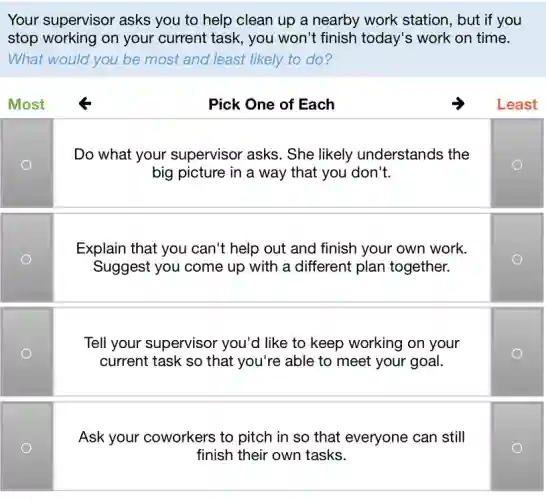
Your supervisor asks you to help clean up a nearby work station , but if you stop working on your current task , you won't finish today's work on time. What would you be most and least likely to do? Most Pick One of Each Least Do what your supervisor asks. She likely understands the big picture in a way that you don't. Explain that you can't help out and finish your own work. Suggest you come up with a different plan together. Tell your supervisor you'd like to keep working on your current task so that you're able to meet your goal. Ask your coworkers to pitch in so that everyone can still finish their own tasks.
Solution4.4(273 votes)
Answer
Explanation
Similar Questions
Isabella likes to meet with her friends in a park every morning for work to practice some yoga poses. She finds that it loosens her up and gets her ready for the day. Even though her yoga may include more than one form of exercise, which type of exercise is Isabella LEAST likely getting during these sessions? endurance exercise strength training balance exercise flexibility training
1. A conscious ; or unconscious reminder of a past trauma . that results in a re -experiencing of the initial trauma , event is known as __ A. Trigger B. Secondary 'Trauma C. Retraumatization D. None of these
Question 4 of 10 Mental illness is: A. very rare. B. found in only 1 out of 100 adults. C. seen usually only in large metropolitan areas. D. common.
Which of the following is the best way for Lusa to encourage Ned to promptly reply? Select an option from the choices below and click Submit. I don't have all day, Ned. Ned, are you still there? Hey,Ned! He's going to be here in less than an hour. Is that enough time?
The price for predictability is often A) long hours. B) increased self -confidence. C) long-term boredom. D) stress and insecurity.
Metacognition is: "thinking about thinking" "thinking about doing" "thinking about seeing" none of the above
Vocabulary Matching Activity 1. Objectivity __ 2. Bias __ 3. Reflection __ 4. Self-Awareness __ 5. Growth Mindset __ A. Thinking carefully about actions and traits B. Viewing yourself fairly and honestly C. Understanding personal strengths and weaknesses D. Belief that skills can improve E. Opinion that prevents fair judgment
What is the best way to improve your communication skills? Avoid conversations with people you don't know well. Speak louder than everyone else Only communicate through texting. Practice active listening and use clear messages.
A Gestalt psychologist would say that: A. it is important to realize the small pieces in everything we see. B. a large picture cannot be seen, only the small pieces. C. perception is important in recognizing subgroups. D. we see a whole instead of many small pieces.
Memory is often a controversial subject because of questions about its __ (1 point) Accuracy Longevity Durability Existence