


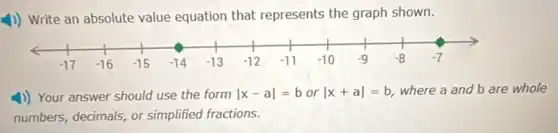
)) Write an absolute value equation that represents the graph shown. 4) Your answer should use the form vert x-avert =borvert x+avert =b where a and b are whole numbers, decimals, or simplified fractions.
Solution4.5(276 votes)
Answer
Explanation
Similar Questions
What is the measure of the central angle of a circle with radius 30 centimeters that intercepts an $18\pi $ centimeters arc? Enter your answer in the box. $\square ^{\circ }$
$\int _{1}^{41}t\sqrt {16+33t}dt=\square $
5. Which of the following expressions is equivalent to $x^{2}-x-30$ A $(x+3)(x-10)$ B. . $(x+6)(x-5)$ C. . $(x-6)(x+5)$ D. $(x-15)(x-15)$
What is the solution to $x-9\gt -15$ 7 $x\lt -24$ $x\lt -6$ $x\gt -6$ $x\gt -24$
Find the product and simplify. $(3c-5)^{2}=\square $
Simplify. $(7xz^{3})^{2}$ Write your answer without parentheses. $\square $
Perform the operation Write the result in standard form. $(-3y+y^{2}-8+5y^{3})+(7y^{2}+4y-2y^{3})$ Enter the correct expressions or values in the boxes to complete the solution process. $(-3y+y^{2}-8+5y^{3})+(7y^{2}+4y-2y^{3})$ The given expression $(\square -8)+(\square +4y)$ Enter the two polynomials in standard form. $(\square -2y^{3})+(\square +7y^{2})+(\square +4y)-8$ Combine like terms. $(\square -2)y^{3}+(\square +7)y^{2}+(\square +4)y-8$ Apply the Distributive Property. $\square $ Enter the simplified result in standard form.
Solve the equation for C. $2-b=log(9c+5)$ $C=$ $\square $
If A is $(0,3)$ and $A'$ is $(0,33)$ , what is the scale factor? $1/3$ 11
Fill in the blank. A statement of the form "expression =expr is called a(n) __ A statement of the form "expression =expr is called a(n) $\square $