


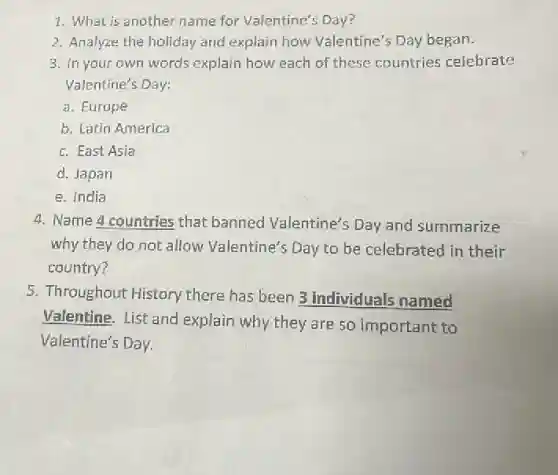
1. What is another name for Valentine's Day? 2. Analyze the holiday and explain how Valentine's Day began. 3. In your own words explain how each of these countries celebrate Valentine's Day: a. Europe b. Latin America c. East Asia d. Japan e. India 4. Name 4 countries that banned Valentine's Day and summarize why they do not allow Valentine's Day to be celebrated in their country? 5. Throughout History there has been 3 individuals named Valentine. List and explain why they are so important to Valentine's Day.
Solution4.0(238 votes)
Answer
Explanation
Similar Questions
Why did the Soviet Union join the Allies? Stalin was afraid of Hitler. Hitler had broken a pact and attackod. Hitler was becoming too powerful in Eastern Europe. Stalin wished to take control of territories captured by Germany.
Order the topics from broadest to narrowest. broader bridge-bullding projects conducted by the Public Works Administration historic infrastructure projects of President Roosevelt's New Deal infrastructure projects conducted by the Public Works Administration historic infrastructure projects of the 20th century
1. How did the world react to Germany's persecution of the Jews and refugees?
What were investors afraid the Federal Reserve Board would do in March 1929? stop sales of RCA stock make it harder to buy and sell stocks on the stock market force the stock market's paper value to match its real value end its policy of deregulation of the stock market
How did Henry IV end religious conflict? How did intendants help Louis XIV centralize power?
Who did the majority of the fighting [and dying) in Europe? The French The Russians The Americans
What impact did the bus boycott have on the city of Montgomery? Select a response. The city became more racially divided. The boycott led to the construction of more buses. The city's bus system became more profitable. The boycott nearly bankrupted the city bus system.
Who led his troops to victory at the Battle of Glorieta Pass? Christopher Bunker Ely S. Parker Joseph Pierce Manual Chavez
13. Which of these areas is bordered by the Euphrates and Tigris Rivers? The Anatolian Peninsula the Rub' al Khali the Fertile Crescent the Hindu Kush
How did Herbert Hoover respond to the Depression? Select an Answer A. He launched a campaign of federal intervention in the economy. B. He asked Americans to grow food for their families and reduce the number of meals they ate per day. C. He reduced the size of the army and used the money saved to help destitute World War I veterans. D. He advocated voluntary action by business and encouraged the work of local charitable organizations.