


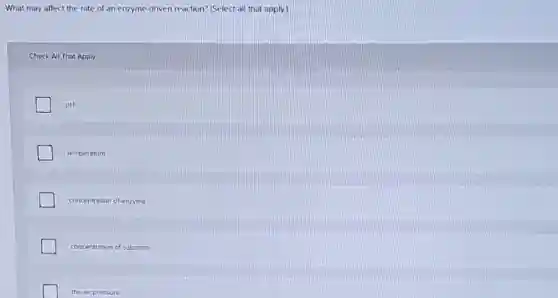
What may affect the rate of an enzyme driven reaction? (Select all that apply) Check All That Apply pH temperature concentration of enzyme concentration of substrate the air pressure
Solution4.6(222 votes)
Answer
Explanation
Similar Questions
A homozygous dominant long-tailed cat mates with a bob-tailed cat. What percent of the offspring will have bob tails? Use the Punnett square you completed in question 12 to answer this ques- tion Scenario In cats, a bob tail, or short tail,is a recessive trait.Long tails are dominant. A $0\% $ B $50\% $ c $100\% $
Is a person's eye color a quantitative or a categorical variable? Pick 1
Enzymes during prophase break down the nuclear membrane and nucleolus so they are no longer visible.Spindle fibers also form in prophase which will attach to the chromosomes. __ are used to break down the nuclear membrane. Blank 1: $\square $
Forthe following scenarios, determine whether the molecules in the scenario are moving by (S) simple diffusion (F) Facilitated diffusion, or (A) active transport. $\square $ For water to travel across the cell membrane at a substantial rate the water molecules travel through protein ein channels known as aquaporins. $\square $ While water molecules are polar, they are also very small. One fact not mentioned in the video is that some water molecules are able to squeeze directly through the phospholipid bilayer due to their small size. $\square $ Charged ions are traveling through a cell membrane using specialized proteins with the concentration gradient. $\square $ Cells lining the gut need to take in glucose, but at a certain time, the conc concentration of extracellular glucose is lower than the concentration already stored in the cells. $\square $ Sodium and potassium must be pumped across the cell membrane with the use of ATP (energy).
Prophase The genetic material inside the nucleus condenses and the chaplicat the first stage of microsis called prophina.the huginning of prophase, the aister thtomatids.strands of condonsed chromos become visiolo. They are attach ind to each other at a poin: cailed the centromane in the cytoplasm, twu tiny organ.alles. called willinglast are invelved in devoloping spindle fibers that span across the cal Metaphase During bratashasi the spincle floers move the centromeros of the duplicated chromason ins to the center of the cell. These spindle fibers are connected to the two near the contrioles and are ready to separate the sister chromarids. Anaphase During anaphase the chromosomes separate and move along the spincle fibers to opposite ends of the cell. Anaphase ends when the Sister chromatids, now cansidered individual chromosomes, are completely separated into two groups and the spincile fibers have almost disappeared. Telophase During Eelophiase, the chromosomes, which were distinct and condensed, begin to spread out into a tangle of chromatin.This is the final stage of mitosis.The nuclear envelope is reconstructed and the nucleolus becomes visible in each new cell. Cytokinesis QKEY QUESTION How do daughter cells split apart after mitosis? In plants, cytokinesis separates the cells by forming a cell plate between the divided nuclei In animals, cytokinesis draws the membrane inward to separate the cells. During the M phase of the cell cycle,mitosis forms two nuclei, each with a complete set of the DNA. The last segment of the Mphase is cytokinesis. Cytokinesis completes the process of cell division by dividing one cell into two. Cytokinesis in Animal Cells The cell membrane is drawn inward and pinched into two new daughter cells Each cell contains the new nucleus formed during mitosis and an equal mount of cytoplasm. ytokinesis in Plants Because of the rigid cell wall outside.the cell membrane in plant cells, pinching from outside inward cannot occur A.cell plate forms halfway ween the two nuclei and with the existing cell membranes. A new cell wall then to separate the two daughter cells. by Sawas Learning Compa BOILD Voenbulary prophase first and longes? phaie ol mitos in which the ganetic material insido the nucious condenses and the chrom osomes become visibin chromatid one of two identical "sister"party of o duplicated chromosome centromere region of chromosome where the two sister chromat ds attach cell that helps to organize coll contriole structure is an animal division which the chromesomes line up metaphase phase of mitosis in across the center of the cell anaphase phase of mitosis in which t e chromosomes separate and move to opposite ands of the cell in which the distinct individual telophase phase of mitosis chromosomes begin to spread out into a tangle of chromatin Prefixes In biology, the prefix telo-means "enci" or "completion." (4) What occurs during of mitosis? telophase that signifies the end __ READING TOOL Compare and Contrast 1) How do chromosomes differ in prokaryotes and eukaryotes? __
Match each part of the vertebral column with its corresponding number of bones Cervical $\square $ Thoracic $\square $ Lumbar $\square $ Sacral $\square $
Match the following: A) elbow B) anterior knee C) posterior knee D) curve of shoulder E) leg F) forearm G) lateral surface of leg H) posterior surface of head D navel J) armpit 10) __ Axillary 11) __ Olecranal 12) __ Delloid 13) __ Antebrachial 14) __ Popliteal 15) __ Umbilical 16) __ Occipital 17) __ Fibular 18) __ Patellar 19) __ Croral
$\square $ 0 of 67 Concepts completed Fill in the Blank Question A eukaryotic cell contains numerous membrane-bound $\square $ each of which performs specific functions that contribute to the cell's survival Need help? Review these concept resources.
Question 3 (2 points) The appearance of the $\square $ crossing over has occurred.
Now let's see if you can identify the variables for your experiment Let's start with hand soap. Here is the research question: Does hand soop reduce bacteriol diversity? $\square $ depends on $\square $ Select an option Selection option Hand soop