


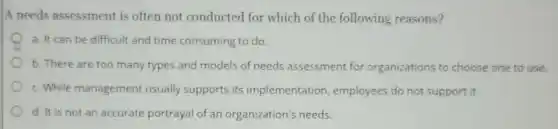
A needs assessment is often not conducted for which of the following reasons? a. It can be difficult and time consuming to do. b. There are too many types and models of needs assessment for organizations to choose one to use. c. While management usually supports its implementation employees do not support it. d. It is not an accurate portrayal of an organization's needs.
Solution4.7(215 votes)
Answer
Explanation
Similar Questions
On September 1, Year 1, Expert Materials, issued at 98 plus accrued interest. $\$ 800,000$ of its $10\% $ bonds. The bonds are dated June 1, Year 1, and mature on May 30, Year 10 Interest is payable semiannually on June 1 and December 1. At the time of issuance, Expert would receive cash of: Multiple Choice $\$ 804,000$ $\$ 784,000$ $\$ 803,600$ $\$ 820,000$
Page 1: 1 2 3 Quiz Information Question 3(1 point) Match the term and definition. $\square $ Expense $\square $ Unearned Revenue $\square $ Time Period Assumption $\square $ Accrual Basis $\square $ Net Income $\square $ Revenue Recognition Principle 1 Payments received for goods that have not yet been delivered or services that have not yet been performed. - The concept that revenue should be recorded when earned, not necessarily when payment is received. - Revenues should be recorded when they are earned and expenses when they are incurred. - The practice of dividing the life of the business into months and years. - Any use or sacrifice of a company's resources to generate revenue. 6. Total revenue minus total expenses.
Question The aim of any currency manipulation by a country's central bank is to try and produce a relatively $\square $ exchange rate, cheaper credit, more jobs, and high economic growth $\square $ I don't know 2 attempts 1/3
A perfectly competitive firm faces the following cost and revenue positions: $ATC=\$ 14,AVC=\$ 10,MR=\$ 6,MC=\$ 6$ . What should they do A) shut down B) remain at position C) decrease output D) increase output
Compute the cost of the inventory shown in Exam Figure B using the FIFO and the LIFO methods of inventory. What is the ending inventory value for the gears using FIFO? A) $\$ 2,416.16$ B) $\$ 2,378.00$ C) $\$ 2,468.60$ D) $\$ 2,499.80$
The majority of product ideas come from entrepreneurs and small business owners. True False
Economies of scale are achieved when a firm reduces its average cost of production as it produces more. can be avoided by purchasing supplies and raw materials in large quantities. help explain the success of small businesses. are available to small firms but not to large firms due to management inefficiencies.
Market economy Prices are set by supply and demand. The invisible hand guides resources to their highest- valued uses. Non-market economy Prices are set by government agencies. Buyers and sellers are motivated by self -interest. Buyers and sellers are motivated by government directives.
Select the correct answer. Where can you find accurate historical stock prices? Financial news websites Social media Weather forecasts Music streaming apps Grocery store
Asasales advisor,what would you say to the customer to select the perfect outfit for them? Let's pull together a few options from our different coilections, and you can choose what you think is most suitable for your new job, I would suggest some timeless pieces for your outfit for a professional look, and then to add a statement plece of clothing or accessory; showing your own personality. I'll put togeticerafew outfit ideas from fashion trendsetters who focusan (1) stylish clothes for creative jobs. We can adjust them to march your personal laste. Our laces: arrivals include some bold patternsiba align well with creative industries.Shall I pull logether some of these for you?