
QuestionSeptember 29, 2026

Questions 1 and 2 refer to the following. (1) A statue of a lamb in Sterling.Massachusetts, commemorates the city as the birthplace of the famous nursery rhyme "Mary Had a Little Lamb (2) The statue's placard attributes the poem to John Roulstone, who, according to popular lore, wrote it circa 1816 after witnessing a girl named - Mary Sawyer bring her lamb to school. (3)When the teacher discovered the lamb, she sent it outside. (4) Although embarrassed by this incident, Sawyer had fond memories of caring for the orphaned lamb, who indeed followed her everywhere. (5) This charming story has long been accepted as the origin of the poem, with Roulstone as the purported author. (6) However strong evidence indicates that this event did not inspire the poem and that the author was in fact Sarah Josepha Hale, not Roulstone. (7) Hale was an accomplished author and editor who, in 1830, first published "Mary's Lamb" in a book of children's poems (8) Later publications of the poem also credited it to Hale. (9)Set to music in 1831 and retitled "Mary Had a Little Lamb," the poem became widely popular. (10) When Sawyer heard the poem, she assumed it was based on Roulstone's verses-which she no longer possessed, incidentally -and in 1876 claimed she was the Mary of the poem and Roulstone was the author (11) Hale denied Sawyer's claims. (12) While no one has ever found a copy of Roulstone's poem, many people, including members of the New England Historical Society. have nevertheless accepted the theory that Hale added three stanzas to Roulstone's original poem, which is childlike in style. (13) Scholars believe Sawyer's account of the lamb following her to school and Roulstone writing a poem about it.(14) However, the Sawyer homestead burned to the ground in 2007. (15) Whereas Hale was a widowed mother of five, Roulstone was a ten-year-old boy who never published anything. (16) It is impossible that Hale, who lived 90 miles away.could have heard Roulstone's The writer wants to avoid expressing the argument of the passage in absolute terms. Which of the following changes should the writer make? A In sentence 2, deleting "according to popular lore" and adjusting the punctuation as needed B In sentence 4, adding "almost" before "everywhere" C In sentence 10, deleting "which she no longer possessed, incidentally" and adjusting the punctuation as needed D In sentence 16, changing "impossible" to "improbable"
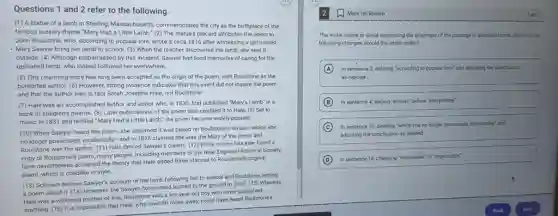
Questions 1 and 2 refer to the following. (1) A statue of a lamb in Sterling.Massachusetts, commemorates the city as the birthplace of the famous nursery rhyme "Mary Had a Little Lamb (2) The statue's placard attributes the poem to John Roulstone, who, according to popular lore, wrote it circa 1816 after witnessing a girl named - Mary Sawyer bring her lamb to school. (3)When the teacher discovered the lamb, she sent it outside. (4) Although embarrassed by this incident, Sawyer had fond memories of caring for the orphaned lamb, who indeed followed her everywhere. (5) This charming story has long been accepted as the origin of the poem, with Roulstone as the purported author. (6) However strong evidence indicates that this event did not inspire the poem and that the author was in fact Sarah Josepha Hale, not Roulstone. (7) Hale was an accomplished author and editor who, in 1830, first published "Mary's Lamb" in a book of children's poems (8) Later publications of the poem also credited it to Hale. (9)Set to music in 1831 and retitled "Mary Had a Little Lamb," the poem became widely popular. (10) When Sawyer heard the poem, she assumed it was based on Roulstone's verses-which she no longer possessed, incidentally -and in 1876 claimed she was the Mary of the poem and Roulstone was the author (11) Hale denied Sawyer's claims. (12) While no one has ever found a copy of Roulstone's poem, many people, including members of the New England Historical Society. have nevertheless accepted the theory that Hale added three stanzas to Roulstone's original poem, which is childlike in style. (13) Scholars believe Sawyer's account of the lamb following her to school and Roulstone writing a poem about it.(14) However, the Sawyer homestead burned to the ground in 2007. (15) Whereas Hale was a widowed mother of five, Roulstone was a ten-year-old boy who never published anything. (16) It is impossible that Hale, who lived 90 miles away.could have heard Roulstone's The writer wants to avoid expressing the argument of the passage in absolute terms. Which of the following changes should the writer make? A In sentence 2, deleting "according to popular lore" and adjusting the punctuation as needed B In sentence 4, adding "almost" before "everywhere" C In sentence 10, deleting "which she no longer possessed, incidentally" and adjusting the punctuation as needed D In sentence 16, changing "impossible" to "improbable"
Questions 1 and 2 refer to the following.
(1) A statue of a lamb in Sterling.Massachusetts, commemorates the city as the birthplace of the
famous nursery rhyme "Mary Had a Little Lamb (2) The statue's placard attributes the poem to
John Roulstone, who, according to popular lore, wrote it circa 1816 after witnessing a girl named
- Mary Sawyer bring her lamb to school. (3)When the teacher discovered the lamb, she sent it
outside. (4) Although embarrassed by this incident, Sawyer had fond memories of caring for the
orphaned lamb, who indeed followed her everywhere.
(5) This charming story has long been accepted as the origin of the poem, with Roulstone as the
purported author. (6) However strong evidence indicates that this event did not inspire the poem
and that the author was in fact Sarah Josepha Hale, not Roulstone.
(7) Hale was an accomplished author and editor who, in 1830, first published "Mary's Lamb" in a
book of children's poems (8) Later publications of the poem also credited it to Hale. (9)Set to
music in 1831 and retitled "Mary Had a Little Lamb," the poem became widely popular.
(10) When Sawyer heard the poem, she assumed it was based on Roulstone's verses-which she
no longer possessed, incidentally -and in
1876 claimed she was the Mary of the poem and
Roulstone was the author (11) Hale denied Sawyer's claims. (12) While no one has ever found a
copy of Roulstone's poem, many people, including members of the New England Historical Society.
have nevertheless accepted the theory that Hale added three stanzas to Roulstone's original
poem, which is childlike in style.
(13) Scholars believe Sawyer's account of the lamb following her to school and Roulstone writing
a poem about it.(14) However, the Sawyer homestead burned to the ground in 2007. (15) Whereas
Hale was a widowed mother of five, Roulstone was a ten-year-old boy who never published
anything. (16) It is impossible that Hale, who lived 90 miles away.could have heard Roulstone's
The writer wants to avoid expressing the argument of the passage in absolute terms. Which of the
following changes should the writer make?
A In sentence 2, deleting "according to popular lore" and adjusting the punctuation
as needed
B In sentence 4, adding "almost" before "everywhere"
C In sentence 10, deleting "which she no longer possessed, incidentally" and
adjusting the punctuation as needed
D In sentence 16, changing "impossible" to "improbable"

Solution
3.5(241 votes)

Answer

D. In sentence 16, changing "impossible" to "improbable" Explanation The question requires identifying which change the writer should make to avoid expressing the argument of the passage in absolute terms. Absolute terms are words that leave no room for doubt or exceptions, such as "always," "never," "impossible," etc. The correct choice should replace an absolute term with a less definitive one. - Option A suggests deleting "according to popular lore" in sentence 2, which does not address the issue of absolute terms. - Option B suggests adding "almost" before "everywhere" in sentence 4, which softens the statement but is not the best choice for avoiding absolute terms in the argument. - Option C suggests deleting "which she no longer possessed, incidentally" in sentence 10, which does not address the issue of absolute terms. - Option D suggests changing "impossible" to "improbable" in sentence 16, which directly addresses the issue by replacing an absolute term with a less definitive one.

Explanation

The question requires identifying which change the writer should make to avoid expressing the argument of the passage in absolute terms. Absolute terms are words that leave no room for doubt or exceptions, such as "always," "never," "impossible," etc. The correct choice should replace an absolute term with a less definitive one.<br /><br />- Option A suggests deleting "according to popular lore" in sentence 2, which does not address the issue of absolute terms.<br />- Option B suggests adding "almost" before "everywhere" in sentence 4, which softens the statement but is not the best choice for avoiding absolute terms in the argument.<br />- Option C suggests deleting "which she no longer possessed, incidentally" in sentence 10, which does not address the issue of absolute terms.<br />- Option D suggests changing "impossible" to "improbable" in sentence 16, which directly addresses the issue by replacing an absolute term with a less definitive one.
Click to rate:

Similar Questions