


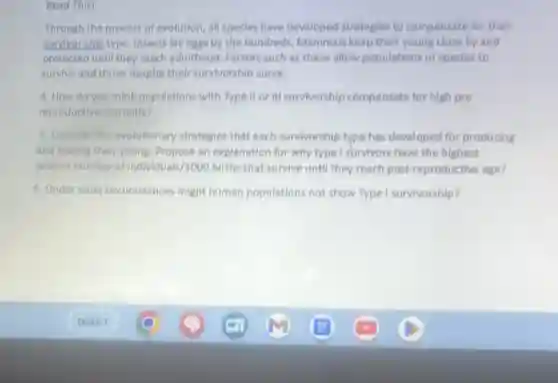
Read This! Through the process of evolution, all species have developed strategies to compensate for their sumvor ship type. Insects lay eggs by the hundreds Mammals keep thelr young close by and protected until they reach adulthood. Factors such as these allow populations of specles to survive and thrive despite their survivorship curve. 4. How do you think populations with Type II or III survivorship compensate for high pre reproductive mortality? 5. Consider the evolutionary strategies that each survivorship type has developed for producing and rearing their young Propose an explanation for why type I survivors have the highest relative number of Individuals /1000 births that survive until they reach post-reproductive age? 6. Under what circumstances might human populations not show Type I survivorship?
Solution3.8(225 votes)
Answer
Explanation
Similar Questions
Part A. Based on the passage above, would polymorphisms be considered a form of mutation? Yes, because there is still a change in the genetic information. No, because there is no negative effect on a person's health. Yes, because they are both common and only affect physical traits No, because they are common enough to be considered a normal variation Part B. Based on the answer to Part A, what determines if someone has a mutation? if the change in the gene sequence causes a negative impact and has no beneficial side if there is any change in the genetic sequence if the change is only significant enough to affect the well-being of an organism ifless than one percent of the population has a changed genetic sequence
Explain the process of human reproduction.
Choose a word from the drop-down menu for each blank to complete the sentences below. The cell membrane in a $\square $ organelle that surrounds cells and allows for the movement of molecules in and out of the cell. This organelle is composed of a $\square $ layer of phospholipids. $\square $ I are also found in the membrane and serve as passageways Choose... for large molecules to pass in and out of the cell. Carbohydrates Triglycerides Proteins (1) Choice Blocker
How do natural selection and environmental factors shape the survival and reproduction of organisms? Watch the video of the praying mantis catching a cricket. What do you think determines which animals survive in nature? How might an organism's traits affect Its chaace. survival and reproduction? What happens to a population if some individuals are better at finding ford'or avoiding predators than others? Construct your response in the space below.
Use the article "Meet the Microbes" to answer questions 1 to 2. 1. How do harmful germs most often enter a person's body? __
1) Drag the terms with the definitions. $\square $ the condition of having nothing in the environment that is septic, or infectious $\square $ a tiny, abnormal protein particle that is much like a virus and causes disease $\square $ an organism that causes infectious disease $\square $ subject to an influence ; capable of being affected by a force
Which statement correctly describes metabolism? A. Metabolism is the process of transporting nutrients to the bloodstream after digestion. B. Metabolism is the process of digestion that takes place in the stomach. C. Metabolism refers to the processes in the body that convert food to energy. D. Metabolism is the action of enzymes on food. E. Metabolism is the process of mechanically breaking down foods.
7.The biomolecule whose monomer is fatty acid and glycerol is:
Composite Breeding System $1/4\square +1/4Siorthom+1/2\square =Beefmaster\quad Catte$
The grizzled giant squirrel in the photo above can be found in the __ ecosystem. A. tropical savanna B. monsoor rainforest C. grassland D. deciduous forest