


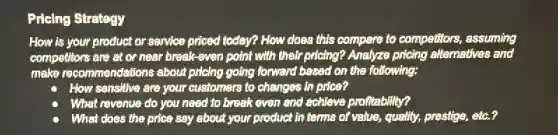
Pricing Strategy How is your product or service priced today?How does this compare to competitors, assuming competitors are at or near break-even point with their pricing? Analyze pricing alternatives and make recommendations about prioing going forward based on the following: How sensitive are your customers to changes in price? What revenue do you need to break even and achieve profitebility? What does the price say about your product in terms of value, quality,prestige, etc.?
Solution3.7(261 votes)
Answer
Explanation
Similar Questions
All of the following statements about a commercial umbrella policy are true EXCEPT A) losses that are excluded from underlying coverage are also excluded from the umbrella policy. B) a commercial umbrella policy provides coverage once the policy limits of an underlying policy have been exhausted C) the insured must have underlying liability coverage before an umbrella policy will be issued D) a commercial umbrella policy is designed to provide catastrophic liability coverage for business risks
14. A key-person insurance policy benefit will pay for which of the following? A. Loss of personal income B. Workers compensation C. Hospital bills of the key employee D. Cost of training a replacement
4. What are automatic stabilizers? How do they help counter the ups and downs of the business cycle?
12. Match the examples with the organizational structures. Janet's, Inc, is a scrapbooking and stationery manufacturing company. It has over 150 individual product lines. Because of the company's __ - manufacturing size, it has divided its teams based on products. Ceramics PLUS is a kitchenware manufacturing company It has clearly defined positions and departments, including a marketing, sales, __ - purchasing, and mechanics departments Martinez Landscaping is a relatively new lawn and garden company. Because of its size and the fact that it hires highly skilled employees, Martine __ - Landscaping is able to give significant autonomy to its employees. Gordon's Food Services helps local restaurants with their food service needs. Gordon's empowers regional employees to fill multiple roles in their __ - own branches. Thus, its workers need to be skilled in several areas.such as sales, purchasing and training.
Part C Will your chasen feld fuild your desires?What changes to your Mestyle preferences will you need to ensure your expanses stay within budget?What do you think you can do to enhance your earning capabilities? $\square $
Pretend your homeowners policy has a premium of $\$ 150$ . a deductible of $\$ 5,000$ , and a limit of $\$ 300,000$ Your home suffers $\$ 170,000$ in damages. How much will you pay for the damages? $\$ 150$ $\$ 5,000$ $\$ 50,000$ $\$ 170,000$ $\$ 165,000$
What is the total cost of renting over 30 years, excluding insurance? To calculate the total rental cost over 30 years, excluding insurance, use the following formula: $Total\quad Rent=Rent_{initial}\times (\frac {(1+r)^{n}-1}{r})\times 12$ Where: - Rentinitial is the initial monthly rent. -r is the annual rent increase rate (in decimal form, e $g.,3\% =0.03$ -n is the number of years (in this case , 30). The total cost of renting over 30 years , excluding insurance, is approximately $ $\square $
What is the definition of "maximum employment'according to the article? A When every individual has a job that matches their skills and preferences. B When the unemployment rate is zero percent. When the economy achieves the lowest possible level lof unempl loyment without accelerating inflation. When the government provides jobs to all willing and able individuals.
Prompt: You are a financial advisor trying to persuade your customers to invest in their futures!It's time for them to stop into your firm and seek guidance when creating a financial portfolio. Use all 20 key terms below to create an informational painphlet (underline each). DO NOT, just define what each of these words mean, be creative Use them appropriately in sentences when creating your pamphlet. Things to think about: Inform your customers on the correct timing to invest! How much are they willing to risk In investments? What's the difference between the $S\& P500$ and Dow Jones? What is the difference between a mutual fund and index fund? Where should they invest and how can they make money off of their investments? What are the hottest stocks to purchase today!!?? KEY TERMS -Asset -Portifilio -Diversification -Risk Tolerance -ROI (Return on Investment) -Compound Interest -Stock-Bond -Mutual Fund -Index Fund -Dividend -Liquidity -Capital Gain -Inflotion -Bull Market -Bear Market-401K -S\$P 500 -Dow Jones -Wall Street -Stock Broker -Financial Advisor
Post-assessment Question 4 of 10 Why should wo list possible solutions in the docision-making process? To make others responsible To make the decision quickly To complicate decision-making To assess all possible options later