


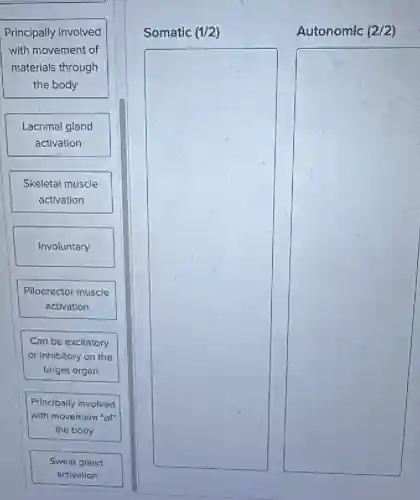
Principally involved with movement of materials through the body Lacrimal gland activation Skeletal muscle activation Involuntary Piloerector muscle activation Can be excitatory or inhibitory on the target organ Principally involved with movement "of" the body Sweat gland activation Somatic (1/2) Autonomic (2/2)
Solution4.0(217 votes)
Answer
Explanation
Similar Questions
$\square $ 0 of 67 Concepts completed Fill in the Blank Question A eukaryotic cell contains numerous membrane-bound $\square $ each of which performs specific functions that contribute to the cell's survival Need help? Review these concept resources.
Question 3 (2 points) The appearance of the $\square $ crossing over has occurred.
Now let's see if you can identify the variables for your experiment Let's start with hand soap. Here is the research question: Does hand soop reduce bacteriol diversity? $\square $ depends on $\square $ Select an option Selection option Hand soop
In the 1700s to early 1900s, fur traders hunted sea otters for their highly valued pelts.Sea otters of the North Pacific Ocean were hunted to near extinction.To this day, some sea otter subspecies are endangered. Choose the best answer for each question. What was the "tragedy"in this scenario? $\square $ What was the "commons"in this scenario? $\square $ What was the human-driver mechanism that created this change? $\square $ Is this an example of tragedy of the commons? $\square $
From conception to approximately 2 weeks after conception, a developing human is called a a. embryo. b. infant. c. zygote. d. fetus.
How does the sympathetic nervous system affect the heart? It returns the heart to resting state contraction It causes the release of norepinephrine, which increases the rate of depolarization It releases hormones for muscle lengthening, which slows heart rate It causes an increase in the plateau phase
Question 3 Question 2 The 'wild-type' phenotype is the most common phenotype observed in a population True False ) Get the answer 1 pts A'wild-type'allele is the allele that is [Select] $\square $ a population, and that encodes a $\square $ functional gene-product. $\square $ Question 4 Which of the following terms refer to the case when a mutation results in a significant decrease or a complete loss of the functional activity of a gene product? gain-of-function mutation loss-of-function mutation 1 pts 1 pts
Which level of organization is formed from two or more different tissues that group together and perform a function? Molecule Organ Organ system Tissue
How long does a biennial plant native to the United States live? (1 point) between one and three months between three and six months between six months and one year between one and two years
Based on its meaning in agriscience, what quality would be expected of perennial fashion? (1 point) appealing intensely for a single season going through boom and bust cycles being associated with a particular decade being popular across years or decades