


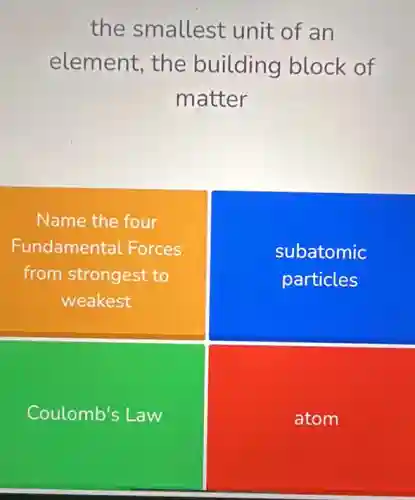
the smallest unit of an element,the building block of matter Name the four Fundamental Forces from strongest to weakest subatomic particles Coulomb's Law atom
Solution4.4(323 votes)
Answer
Explanation
Similar Questions
G. A helium balloon is dunked into a bucket of liquid nitrogen $(T=75K$ ). What change occurs to the balloon if you allow it to return to room temperature?
Atoms are electrically neutral when They have a minimal charge. They have a balanced number of protons and neutrons. They have a balanced number of protons and electrons. They have no valance electrons.
2. Suppose that hot coffee has a temperature of $90^{\circ }C$ in the coffee pot.You pour a serving of volume of 0.10 L into a ceramic coffee mug (specific heat $940J/kg^{\circ }C)$ that has a mass of 0.30 kg and is initially at $20^{\circ }C$ . What is the temperature of your coffee when the coffee and mug reach thermal equilibrium?
Ultraviolet (UV) radiation X-ray radiation, and some chemicals are all: a causes of mutations. b used in barbecuing. c treatments against radiation contamination. d none of these
What happens when an object vibrates in air? A. Light waves form B. Molecules bump into each other C. Energy disappears D. Space expands
Which is not a piece of evidence that most scientists use to prove the origin of our universe? Movement of the galaxies (expansion) Cosmic microwave background radiation Presence of hydrogen and helium in the correct percentages throughout the universe The contraction of objects in space
16. A student calculates speed using the formula $speed=distance\div time$ Why is this formula useful? A. It tells how far an object can fall B. It shows how fast an object moves C. It explains why objects stop D. It measures acceleration
What is the wavelength of a 440 Hz sound traveling with a speed of $347m/s$ $Answer=$ $\square $
If Star A has three times the surface temperature of the Sun but has the same luminosity as the Sun, the radius of star A must be __ the radius of the Sun. $1/3$ 3 times $1/9$ 81 times
10. If you move a magnet in and out of a coil faster will the induced current be stronger or weaker? Explain.