


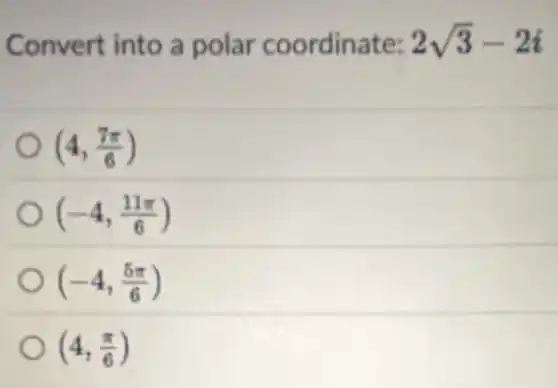
Convert into a polar coordinate: 2sqrt (3)-2i (4,(7pi )/(6)) (-4,(11pi )/(6)) (-4,(5pi )/(6)) (4,(pi )/(6))
Solution4.0(215 votes)
Answer
Explanation
Similar Questions
Simplify the Rational Expression $\frac {x^{2}-9}{x^{2}+x-6}$
7. A fair six-sided die is rolled. What are the odds of getting a 3 or higher. Leave your answer as a reduced fraction. $\square $
Find $(2(cos\frac {2\pi }{3}+isin\frac {2\pi }{3}))^{5}$ $-16-16i\sqrt {3}$ $16+16i\sqrt {3}$ $16\sqrt {3}+16i$ $-16\sqrt {3}-16i$
Convert into a complex number: $2(cos\frac {4\pi }{3}+isin\frac {4\pi }{3})$ $-\sqrt {3}-i$ $\sqrt {3}-i$ $-1-i\sqrt {3}$ $1+i\sqrt {3}$
10. Simplify the expression. $\sqrt {125t^{4}r^{3}s^{13}}$
1. What is the simplified form of $-\sqrt {(y+5)^{16}}$ A. $(y+5)^{8}$ B. $-(y+5)^{8}$ C. $(y+5)^{4}$ D. $-(y+5)^{4}$
Which quadrilateral does not have diagonals that are perpendicular? Rectangle Rhombus Square
Simplify the following expression completely. $\frac {x^{2}-14x+45}{x^{2}-18x+81}$
What is the measure of an exterior angle in a regular 15-gon? Write your answer as an integer or as a decimal rounded to the nearest tenth.
Find the distance between the given points. $(-3,1)$ and $(12,37)$ $\square $