


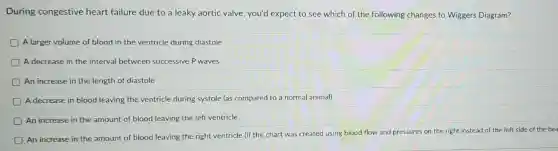
During congestive heart failure due to a leaky aortic valve you'd expect to see which of the following changes to Wiggers Diagram? A larger volume of blood in the ventricle during diastole A decrease in the interval between successive P waves An increase in the length of diastole A decrease in blood leaving the ventricle during systole (as compared to a normal animal) An increase in the amount of blood leaving the left ventricle D An increase in the amount of blood leaving the right ventricle (if the chart was created using blood flow and pressures on the right instead of the left side of the hea
Solution4.5(237 votes)
Answer
Explanation
Similar Questions
1. What are two examples of localized cancer therapy? 2. How is chemotherapy different?
handwashing process? Select all that apply Wet hands with warm water Scrub with soap for 20 seconds Dry hands with paper towel, throw it away and then turn off the faucet Lather with soap for at least 5 seconds Scroll
Which of the following is considered a non -modifiable risk factor for Atherosclerosis? Select one A. Obesity B. Smoking C. Age D. Hyperlipidemia E. Hypertension
Which of these urine tests would show a patient with proteinuria? Foul smelling urine Protein excretion in urine of $200mg/day$ Crystals in the urine Tea-colored urine
10. Anthony has noticed that one of his testicles is swollen. He did not feel comfortable talking about the problem, but it is not going away. What steps would you suggest that Anthony take?
The half-life of Ativan is about 14 hours. How much of a 2 mg dose would remain in the body after 6 hours?
The drug used in acetaminophen overdose is naloxone. salicylic acid. N-acetylcysteine. flumazenil.
Which emergency use medication has an antianginal mechanism of action? Phenytoin Nitroglycerin Lidocaine Amiodarone
What does an ophthalmologist treat? A. heart conditions B. eye injuries C. cancer D. infectious disease
What is respiratory distress? A. A condition where the heart is not getting enough blood B. A condition where the lungs are not getting enough oxygen C. A condition where the heart is not getting enough oxygen D. A condition where the brain is not getting enough oxygen