


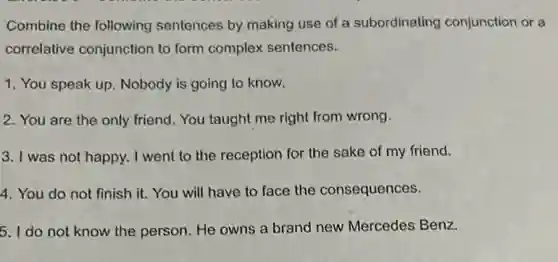
Combine the following sentences by making use of a subordinating conjunction or a correlative conjunction to form complex sentences. 1. You speak up Nobody is going to know. 2. You are the only friend. You taught me right from wrong. 3. I was not happy I went to the reception for the sake of my friend. 4. You do not finish it. You will have to face the consequences. 5. I do not know the person. He owns a brand new Mercedes Benz.
Solution4.2(82 votes)
Answer
Explanation
Similar Questions
What was the name of the record company that produced the sound and movement arrangement represented in this performance? OSU Web Login Service NOTE: In addition to the cases below. a new possible source of this error is the use of Apple's ICloud Private Relay feature, available on newer iPhone, Pad, and Mac devices This feature is not compatible with the university's Web Login Service at this time, so you Direct Link to video B (opens in a new window) Motown Records Soul Studios Virgin Records
Multiple Choice African drums are not only musical instruments, but also an art form. (1 point) true false
First Read: Concept Vocabulary Identify the choice that best answers the question. What have you done if you have fled a situation? A. caused it B. changed it C. ran away from it D. introduced others to it
First Read: Concept Vocabulary Identify the choice that best answers the question. If you are dispossessed of something, which of the following must be true? A. You have lost it. B. You have found I it. C. You have learned about it. D. You have taught someone about it.
The practice of singing Psalms in church is called: Hymnody Psalter Psalmody
Select all of the terms that have to do with timbre of music. tempo rhythm acoustic electronic tone quality
3. Which city name means "House of Goblins"? San Cristóbal Cucuta Mexico City
Use these words to complete the sentences below: brace embrace capital captain Grief-stricken, Ashley fell into her mother's $\square $ and wept. Does anyone know the $\square $ of Kansas?
What type of note is this? 32nd note Quarter note Sixteenth note Eighth note
¿Qué significa tener? to have to be to want to teach