
QuestionDecember 18, 2025

Finding Main Ideas The following questions deal with reforms in public education. Answer them in the space provided. 1. What percentage of women held jobs by the turn of the 20th century? What types of work did they do? __ 2. How did many African-American women earn a living cluring the late 1800 s? __ 3. Why were many women opposed to the Fourteenth and Fifteenth Amendments? __ 4. What were the main reform movements in which many women participated? __ 5. What groups opposed woman suffrage and why? __ 6. What were the three approaches suffragists tried to achieve their objectives?
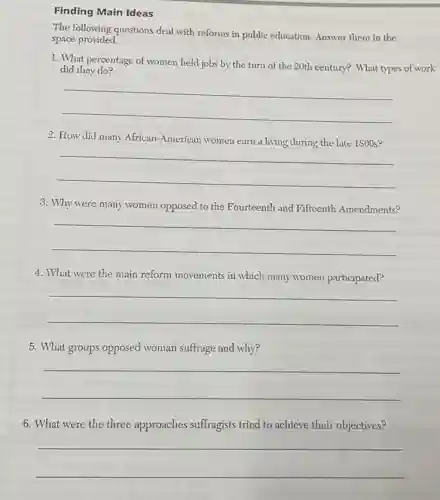
Finding Main Ideas The following questions deal with reforms in public education. Answer them in the space provided. 1. What percentage of women held jobs by the turn of the 20th century? What types of work did they do? __ 2. How did many African-American women earn a living cluring the late 1800 s? __ 3. Why were many women opposed to the Fourteenth and Fifteenth Amendments? __ 4. What were the main reform movements in which many women participated? __ 5. What groups opposed woman suffrage and why? __ 6. What were the three approaches suffragists tried to achieve their objectives?
Finding Main Ideas
The following questions deal with reforms in public education. Answer them in the
space provided.
1. What percentage of women held jobs by the turn of the 20th century? What types of work
did they do?
__
2. How did many African-American women earn a living cluring the late 1800 s?
__
3. Why were many women opposed to the Fourteenth and Fifteenth Amendments?
__
4. What were the main reform movements in which many women participated?
__
5. What groups opposed woman suffrage and why?
__
6. What were the three approaches suffragists tried to achieve their objectives?

Solution
4.3(304 votes)

Answer

1. Approximately 20% of women held jobs; they worked in domestic service, teaching, nursing, clerical jobs, and factories. 2. African-American women worked as domestic servants, laundresses, and in agriculture. 3. Women opposed the Fourteenth and Fifteenth Amendments because they did not grant women the right to vote. 4. Women participated in the suffrage, temperance, and labor reform movements. 5. Opponents of woman suffrage included liquor interests, textile manufacturers, and some religious groups. 6. Suffragists lobbied state legislatures, pursued court cases, and pushed for a constitutional amendment. Explanation 1. By the turn of the 20th century, approximately 20% of women held jobs. They primarily worked in domestic service, teaching, nursing, and clerical positions, as well as in factories. 2. Many African-American women earned a living during the late 1800s by working as domestic servants, laundresses, and in agricultural labor. 3. Many women opposed the Fourteenth and Fifteenth Amendments because these amendments granted citizenship and voting rights to African-American men but did not extend the same rights to women. 4. The main reform movements in which many women participated included the suffrage movement, temperance movement, and labor reform. 5. Groups that opposed woman suffrage included liquor interests, textile manufacturers, and some religious groups, often because they believed that women voting would support prohibition and labor reforms that could negatively impact their interests. 6. The three approaches suffragists tried to achieve their objectives were: lobbying state legislatures to grant women the right to vote, pursuing court cases to test the Fourteenth Amendment, and pushing for a national constitutional amendment.

Explanation

1. By the turn of the 20th century, approximately 20% of women held jobs. They primarily worked in domestic service, teaching, nursing, and clerical positions, as well as in factories.<br />2. Many African-American women earned a living during the late 1800s by working as domestic servants, laundresses, and in agricultural labor.<br />3. Many women opposed the Fourteenth and Fifteenth Amendments because these amendments granted citizenship and voting rights to African-American men but did not extend the same rights to women.<br />4. The main reform movements in which many women participated included the suffrage movement, temperance movement, and labor reform.<br />5. Groups that opposed woman suffrage included liquor interests, textile manufacturers, and some religious groups, often because they believed that women voting would support prohibition and labor reforms that could negatively impact their interests.<br />6. The three approaches suffragists tried to achieve their objectives were: lobbying state legislatures to grant women the right to vote, pursuing court cases to test the Fourteenth Amendment, and pushing for a national constitutional amendment.
Click to rate:

Similar Questions