


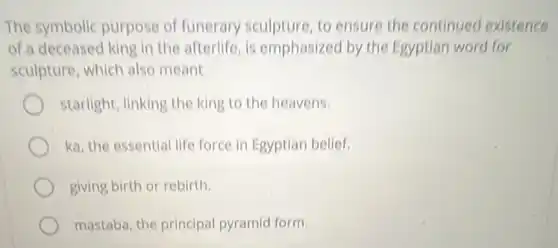
The symbolic purpose of funerary sculpture, to ensure the continued existence of a deceased king in the afterlife, is emphasized by the Egyptian word for sculpture, which also meant starlight, linking the king to the heavens. ka, the essential life force in Egyptian belief. giving birth or rebirth. mastaba, the principal pyramid form.
Solution4.4(206 votes)
Answer
Explanation
Similar Questions
Highlight all the words that make up the independent clause below. Candace Flynn gracefully danced her solo at the holiday show.
Which rule did you use to read the word highest? Place it in the correct column. Base Word with Suffix Compound Word $\square $ $\square $
"Dénouement" is another word for: The Rising Action The Dialogue The Resolution/Final Outcome The Main Theme
Question 5 Correct the ambiguous pronoun in the following sentence: When Sarah spoke to Emily, she looked upset. Edit View Insert Format Tools Table
Instructions Match each underlined vocabulary word with its corresponding synonym: Vocabulary Word Options (5 of 5) predominating prudence depreciate laboriously ransacking Synonym holding sway lose value scouring good judgment
Some letter names contain letter sounds. For each letter prompt, determine if/where the sound occurs in the letter's name. Letter: b Sound at the beginning of the name. Sound at the end of the name. Sound not in the name.
Her argument lacked the basic __ necessary to convince the board. leverage chorographed devoured logic
5 There's no way John is at home. I knocked on the door for about five minutes. I suppose that he __ o might have gone out shouldn't have gone out couldn't have gone out must be gone out
Vocab 24 - March 20 (MP 4) Squalid - very dirty and unpleasant, a result of poverty or neglect Stertorous - noisy and labored breathing Erudition - the quality of having or showing great knowledge or learning; scholarship. Cachinnation - a loud, convulsive, or excessive laughter Extirpation - the local or regional elimination of a species from a given area, while the species still exists elsewhere
Which is the best example of __ A. When a rat presses a lever, a treat is removed The rat rarely presses the lever. B. When a rat presses a lever, a painful shock is removed. The rat frequently presses the lever. C. When a rat presses a lever it receives a treat. The rat frequently presses the lever. D. When a rat presses a lever it receives a painful shock. The rat rarely presses the lever.