


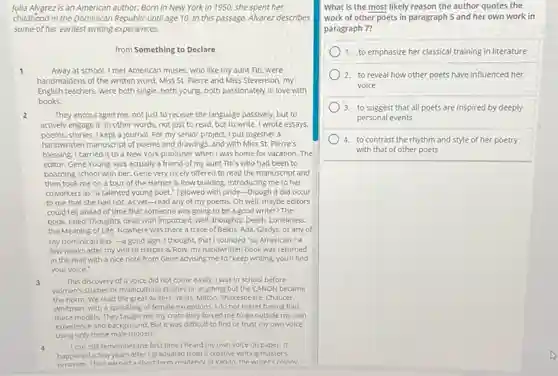
Julia Alvarez is an American author. Born in New York in 1950 she spent her childhood in the Dominican Republic until age 10. In this passage. Alvarez describes some of her earliest writing experiences. from Something to Declare 1 Away at school, I met American muses, who like my aunt Titi, were handmaidens of the written word. Miss St. Pierre and Miss Stevenson, my English teachers, were both single, both young, both passionately in love with books. 2 They encouraged me, not just to receive the language passively, but to actively engage it. In other words, not just to read, but to write. I wrote essays. poems, stories. I kept a journal. For my senior project. I put together a handwritten manuscript of poems and drawings, and with Miss St. Pierre's blessing. I carried it to a New York publisher when I was home for vacation.The editor, Gene Young, was actually a friend of my aunt Titi's who had been to boarding school with her.Gene very nicely offered to read the manuscript and then took me on a tour of the Harper & Row building introducing me to her coworkers as "a talented young poet."I glowed with pride-though it did occur to me that she had not, as yet-read any of my poems.Oh well, maybe editors could tell ahead of time that someone was going to be a good writer? The book, titled Thoughts dealt with important, well, thoughts: Death Loneliness. the Meaning of Life Nowhere was there a trace of Belkis, Ada, Gladys.or any of my Dominican tias-3 good sign. I thought, that I sounded "so American." A few weeks after my visit to Harper 8 Row, my handwritten book was returned in the mail with a nice note from Gene advising me to "keep writing, you'll find your voice." 3 This discovery of a voice did not come easily. I was in school before women's studies or multicultural studies or anything but the CANON became the norm. We read the great writers. Yeats Milton, Shakespeare, Chaucer, Whitman, with a sprinkling of female exceptions, I do not regret having had these models. They taught me my craft: they forced me to go outside my own experience and background. But it was difficult to find or trust my own voice using only these male models. 4 I can still remember the first time I heard my own voice on paper, it happened a few years after I graduated from a creative writing master's had earned a short-term residencv at Yaddo. the writer's colonv What is the most likely reason the author quotes the work of other poets in paragraph 5 and her own work in paragraph 7? 1. to emphasize her classical training in literature 2.to reveal how other poets have influenced her voice 3. to suggest that all poets are inspired by deeply personal events 4. to contrast the rhythm and style of her poetry with that of other poets
Solution4.4(200 votes)
Answer
Explanation
Similar Questions
2. Throughout the film Harriet Tubman experiences seizures and periods of unconsciousness.How does she interpret these episodes? __
(1) What is a disadvantage to Florida's Python Hunt? a. It will eliminate all of the Burmese pythons in the area. b. People might get hurt. c. It's too late to fix the damage caused by the pythons. d. Too many tourists will hurt the local community. ) Which words best support your answer to Question 4? a. "The python's unique hinged jaws allow it to swallow an object five times as wide as its own head."(Source 1) b. __ many who have never even seen a Burmese python __ (Source 2) c. "Dying to get some cash into your pitifully small bank account?" (Source 3) d. "These animals are in the Florida because we brought them here." (Source 4) Prose Constructed -Response What is one claim you can make about humans'involvement in the python problem?Cite text evidence from least two of the sources.
How does the author use dialogue to propel the action of the narrative? It is used to show the conflicts that occurred during the journey, and Tubman's ability to reason with the fugitives. It is used to add suspension at the "stops". It is used to show the fear people have when they supported the Underground Railroad. It is used to show the relationship Tubman had as a leader over the other fugitives.
3 PART A: How does the speaker use irony when addressing the landlady and responding to her questions? A. The speaker appears polite in conversation with the landlady when in reality they are making fun of her. B. The speaker goes out of their way to be polite and respectful to the landlady to convince her to rent the property to them, C. The speaker is polite and considerate to the landlady to draw attention to how rude she is being to them, D. The speaker is kind and respectful towards the landlady.hoping that it will cause her to be friendlier towards them. 4. PART B: Which quote from the text best supports the answer to Part A? A. "I hate a wasted journey-I am African." Silence. Stenced transmission of (Lines $5-6)$ B. "By il-mannered silence.surrender / Pushed dumblounded to beg simplification." curses $15-16)$ C. "Flight of fancy, till truthfuness clanged her accent Mard on the mouthpiece WHATS THAT? Conceding" [Lines 24-25] D. "About my ears -Madam,"I pleaded, "wouldn't you rather / See for yourself" quines $34-35)$ 5. How do lines $10-14$ Jevelop the speaker's point of view in the poem?
Books Can Transform How is it possible for a favorite book to transform you? Answer in 1 to 3 complete sentences. A book can transform a person be- cause __ This transformation can happen be- cause __
Fix any punctuation or capitalization errors below.Click "Submit Answer" if there are none Mufasa gently stroked the puppy's soft,velvety fur.
9. Despite the damage to their house and their horrifying experience during the battle, the Henry family remained in the area. How do you think their ir lives were affected by what had happened across their helds?Please respond thoughtfully and incomplete sentences (4pts) $\square $
IS ut king the "So lained, ther ering re while In what way could this fictional story relate to the real world? x A The story shows the corruption found in team sports today. B The story may help someone cut from a team feel some comfort. C The story demonstrates how cruel and callous some coaches can be D The story shows that jealousy can sometimes have positive effects.
You try it! Identify and circle the subordinating conjunction in each sentence. Label Independent and dependent clauses. Add commas when necessary. 1. When I met Susan her eyes were red because she had been crying. 2. We searched the woods around the lake where Adam would often walk when he was feeling blue. 3. He will always be considered as the town's bravest man provided the truth never comes out. 4. Although I've been here before he's just too hard to ignore. 5. Because it was raining I took my umbrella. 6. Since I have no money I can't go to the movie. 7. Ilost my job because I was often late. 8. John is short whereas Mary is tall. 9. Paula was given the position even though she had no experience. 10. Unless you practice your basketball skills will never improve.
1. What is the meaning of the word banned? What clues in the text help you know? __