


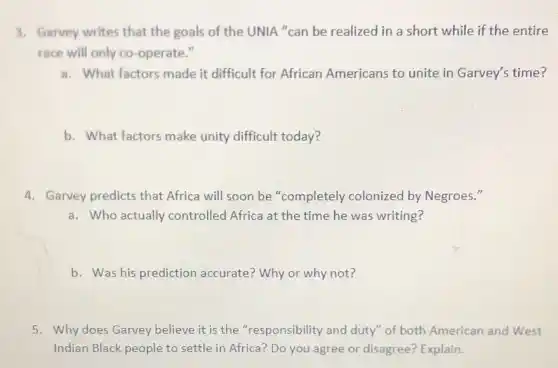
3. Garvey writes that the goals of the UNIA "can be realized in a short while if the entire race will only co -operate." a. What factors made it difficult for African Americans to unite in Garvey's time? b. What factors make unity difficult today? 4. Garvey predicts that Africa will soon be "completely colonized by Negroes." a. Who actually controlled Africa at the time he was writing? b. Was his prediction accurate? Why or why not? 5. Why does Garvey believe it is the "responsibility and duty" of both American and West Indian Black people to settle in Africa? Do you agree or disagree?Explain.
Solution4.5(197 votes)
Answer
Explanation
Similar Questions
Select the correct answer. Which is the most important role of the Nile River in the development of Egyptian civilization? A. The Nile made the nearby lands fertile. B. The Nile protected Egypt from foreign intruders. C. The Nile helped with transportation in Egypt
What attitude does Lincoln promote for the nation as the war comes to an end? Forgiveness, unity, and healing Punishment and revenge against the South Celebration of military victory Continued division between regions
1. What ideas influenced Gandhi's belief in nonviolent resistance? 2. Why did Gandhi use the spinning wheel as a symbol for India 's independence? 3. How did Gandhi keep his protests peaceful? 4. Why did Gandhi choose to protest the British salt laws, and what did they symbolize? 5. What happened during the Salt March, and how did people across India join Gandhi's movement? 6. How did the Salt March change world opinion about British rule in India?
How did the Treaty of Versailles lay the foundation for World War II? Why would the German people support a leader like Adolf Hitler? Use evidence from the text to support your answer. Would a powerful or weak nation be more likely to practice isolationism? Explain your answer.
Select All the things the CCC did that changed America. Provided Electricity to locals in Appalachia Plant Trees Build Parks Built New Roads
2. Analyzing How was the growth of cities intertwined with the growth of trade? $\square $
What is the correct definition of the Treaty of Guadalupe-Hidalgo? It was the peace treaty ending the United States War with Mexico. It was the treaty that made Mexico City part of Texas. It was the treaty signed to begin an armistice after the Battle of Monterrey. It was the treaty signed to bring the Texas Rangers into the war.
Where did the United States want the southern Texas border to extend to? Mexico City Nueces River Rio Grande Gulf Coast
Why did Madison and Hamilton push for George Washington to attend the 1787 meeting? He promised to end the Articles of Confederation He controlled state militias He could write the constitution himself His presence gave legitimacy
Who wrote the famous decision outlawing segregated education in the United States? A. Martin Luther King Jr. B. John M. Harlan C. Thurgood Marshall D. Earl Warren