
QuestionJune 2, 2026

Designing a party platform Involves __ Select all that apply. presenting a plank to the party and getting people to vote on it presenting a plank on identified issues and deciding how to vote on them encouraging party members to "stand on" the bus to move it forward pledging to translate planks into laws making it impossible for a candidate to run if they don't agree with every issue on the party platform
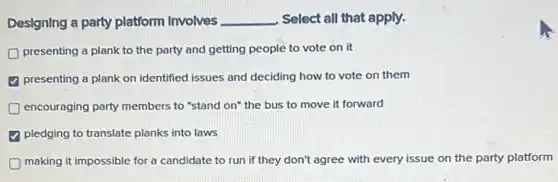
Designing a party platform Involves __ Select all that apply. presenting a plank to the party and getting people to vote on it presenting a plank on identified issues and deciding how to vote on them encouraging party members to "stand on" the bus to move it forward pledging to translate planks into laws making it impossible for a candidate to run if they don't agree with every issue on the party platform
Designing a party platform Involves __ Select all that apply.
presenting a plank to the party and getting people to vote on it
presenting a plank on identified issues and deciding how to vote on them
encouraging party members to "stand on" the bus to move it forward
pledging to translate planks into laws
making it impossible for a candidate to run if they don't agree with every issue on the party platform

Solution
4.6(161 votes)

Answer

The correct options are: - Presenting a plank to the party and getting people to vote on it. - Presenting a plank on identified issues and deciding how to vote on them. - Pledging to translate planks into laws. Explanation A party platform refers to a set of principal goals supported by a political party to appeal to its members and the public. Designing a party platform involves constructing planks (policies on specific issues), getting consensus, deciding on voting strategies, and pledging actionable steps towards implementing policies if elected. However, it doesn't involve absurd actions like standing on buses or automatically disqualifying candidates based on disagreements with the platform. 1. **Presenting a plank to the party and getting people to vote on it**: This describes a typical process of platform creation, where planks are proposed and party members vote. 2. **Presenting a plank on identified issues and deciding how to vote on them**: Correct—this reflects the identification of specific topics and deciding strategies for addressing them. 3. **Encouraging party members to "stand on" the bus to move it forward**: Not correct—this is metaphorical nonsense in this context. 4. **Pledging to translate planks into laws**: Correct—this highlights actionable steps to bring the platform’s issues into real-world governance. 5. **Making it impossible for a candidate to run if they don't agree with every issue on the party platform**: Not correct—Party platforms often allow flexibility and room for individual candidate views on certain issues.

Explanation

A party platform refers to a set of principal goals supported by a political party to appeal to its members and the public. Designing a party platform involves constructing planks (policies on specific issues), getting consensus, deciding on voting strategies, and pledging actionable steps towards implementing policies if elected. However, it doesn't involve absurd actions like standing on buses or automatically disqualifying candidates based on disagreements with the platform.<br /><br />1. **Presenting a plank to the party and getting people to vote on it**: This describes a typical process of platform creation, where planks are proposed and party members vote.<br /><br />2. **Presenting a plank on identified issues and deciding how to vote on them**: Correct—this reflects the identification of specific topics and deciding strategies for addressing them.<br /><br />3. **Encouraging party members to "stand on" the bus to move it forward**: Not correct—this is metaphorical nonsense in this context.<br /><br />4. **Pledging to translate planks into laws**: Correct—this highlights actionable steps to bring the platform’s issues into real-world governance.<br /><br />5. **Making it impossible for a candidate to run if they don't agree with every issue on the party platform**: Not correct—Party platforms often allow flexibility and room for individual candidate views on certain issues.<br /><br />
Click to rate: