


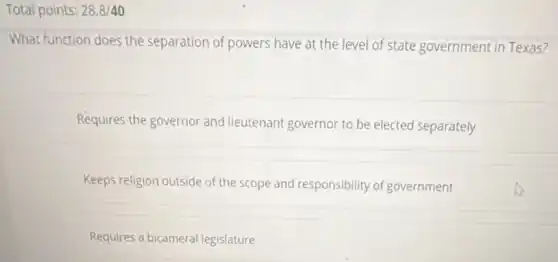
Total points: 28.8/40 What function does the separation of powers have at the level of state government in Texas? Requires the governor and lieutenant governor to be elected separately Keeps religion outside of the scope and responsibility of government Requires a bicameral legislature
Solution4.5(266 votes)
Answer
Explanation
Similar Questions
Designing a party platform Involves __ Select all that apply. presenting a plank to the party and getting people to vote on it presenting a plank on identified issues and deciding how to vote on them encouraging party members to "stand on" the bus to move it forward pledging to translate planks into laws making it impossible for a candidate to run if they don't agree with every issue on the party platform
James and Pascal both offer a(n) __ justification of belief in God. scientific epistemic pragmatic moral
Which of the following were often excluded from citizenship? A. political figures B. men C. immigrants D. children
What is not a duty of the federal government? running the postal system printing money maintaining an army issuing licenses
The Green Party believes in a universal basic income that would go to every adult, regardless of their employment or health status. True False
The amount of federal grant money going to states has steadily decreased since the 1960s. True False
Which level of government prints money? state federal both state and federal local and municipal
According to Aristotle self-sufficiency is a key characteristic of happiness. a) False. b) True.
2. COMPARE AND CONTRAST How did Jean -Jacques Rousseau's social contract differ from John Locke's?
Which type of government would most likely own a country's farming industry and distribute food equally to its citizens? A. Democratic B. Fascist C. Czarist D. Socialist