
QuestionFebruary 18, 2026

Tool Required:Depth Micrometer 19.Which way do you turn the lock nut to engage and disengage the lock on the depth rod and how far does it turn? a. Engage clockwi se/Disengage counterclockwise b. Disengage clockwise/Engage counterclockwise 20.With the lock nut disengaged turn the thimble counterclockwise what happens to the depth rod? a. It retracts b. It extends c. Nothing 21.Turn the thimble clockwise, without returning to "zero" and describe what hap- pens? a. It retracts b. It extends c. Nothing 22.Now do the same thing using the ratchet stop/speeder.Is there a difference in resistance? a. Yes b. No 23.Lock the depth rod with the lock nut and attempt to turn the ratchet stop! speeder. What happens? a. Nothing b. The depth rod moves and the ratchet does not click c. The depth rod moves and the ratchet clicks d. The depth rod does not move and the ratchet clicks 24.Using the ratchet stop/speeder return the micrometer to the "zero position on the sleeve. Is the measuring rod flush with the base? a. Yes b. No 25.Replace the 0 -1" measuring rod with the 1-2'' measuring rod. Turn the thimble to the "zero" on the sleeve. Does the measuring rod extend out of the base? a. Yes b. No
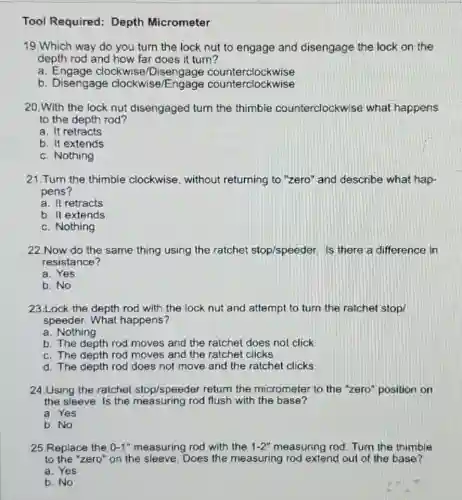
Tool Required:Depth Micrometer 19.Which way do you turn the lock nut to engage and disengage the lock on the depth rod and how far does it turn? a. Engage clockwi se/Disengage counterclockwise b. Disengage clockwise/Engage counterclockwise 20.With the lock nut disengaged turn the thimble counterclockwise what happens to the depth rod? a. It retracts b. It extends c. Nothing 21.Turn the thimble clockwise, without returning to "zero" and describe what hap- pens? a. It retracts b. It extends c. Nothing 22.Now do the same thing using the ratchet stop/speeder.Is there a difference in resistance? a. Yes b. No 23.Lock the depth rod with the lock nut and attempt to turn the ratchet stop! speeder. What happens? a. Nothing b. The depth rod moves and the ratchet does not click c. The depth rod moves and the ratchet clicks d. The depth rod does not move and the ratchet clicks 24.Using the ratchet stop/speeder return the micrometer to the "zero position on the sleeve. Is the measuring rod flush with the base? a. Yes b. No 25.Replace the 0 -1" measuring rod with the 1-2'' measuring rod. Turn the thimble to the "zero" on the sleeve. Does the measuring rod extend out of the base? a. Yes b. No
Tool Required:Depth Micrometer
19.Which way do you turn the lock nut to engage and disengage the lock on the
depth rod and how far does it turn?
a. Engage clockwi se/Disengage counterclockwise
b. Disengage clockwise/Engage counterclockwise
20.With the lock nut disengaged turn the thimble counterclockwise what happens
to the depth rod?
a. It retracts
b. It extends
c. Nothing
21.Turn the thimble clockwise, without returning to "zero" and describe what hap-
pens?
a. It retracts
b. It extends
c. Nothing
22.Now do the same thing using the ratchet stop/speeder.Is there a difference in
resistance?
a. Yes
b. No
23.Lock the depth rod with the lock nut and attempt to turn the ratchet stop!
speeder. What happens?
a. Nothing
b. The depth rod moves and the ratchet does not click
c. The depth rod moves and the ratchet clicks
d. The depth rod does not move and the ratchet clicks
24.Using the ratchet stop/speeder return the micrometer to the "zero position on
the sleeve. Is the measuring rod flush with the base?
a. Yes
b. No
25.Replace the 0 -1" measuring rod with the 1-2'' measuring rod. Turn the thimble
to the "zero" on the sleeve. Does the measuring rod extend out of the base?
a. Yes
b. No

Solution
4.3(205 votes)

Answer

19: a ### 20: b ### 21: a ### 22: b ### 23: d ### 24: a ### 25: a Explanation 1. Determine lock nut operation Engaging the lock nut requires turning it clockwise; disengaging requires turning counterclockwise → Correct answer is option a for Q19. 2. Effect of thimble counterclockwise with lock nut disengaged Counterclockwise turns extend the depth rod → Correct answer is option b for Q20. 3. Thimble clockwise without zero reset Clockwise turns retract the depth rod → Correct answer is option a for Q21. 4. Ratchet stop/speeder resistance difference Ratchet stop provides consistent resistance like thimble → No difference → Correct answer is option b for Q22. 5. Lock nut engaged and ratchet stop/speeder turned Lock prevents rod movement; ratchet clicks → Correct answer is option d for Q23. 6. Ratchet stop/speeder to zero position At zero, measuring rod is flush with base → Correct answer is option a for Q24. 7. Replacing rod with longer range and zero position Longer rod extends out of base even at zero → Correct answer is option a for Q25.

Explanation

1. Determine lock nut operation <br /> Engaging the lock nut requires turning it clockwise; disengaging requires turning counterclockwise → Correct answer is option a for Q19. <br />2. Effect of thimble counterclockwise with lock nut disengaged <br /> Counterclockwise turns extend the depth rod → Correct answer is option b for Q20. <br />3. Thimble clockwise without zero reset <br /> Clockwise turns retract the depth rod → Correct answer is option a for Q21. <br />4. Ratchet stop/speeder resistance difference <br /> Ratchet stop provides consistent resistance like thimble → No difference → Correct answer is option b for Q22. <br />5. Lock nut engaged and ratchet stop/speeder turned <br /> Lock prevents rod movement; ratchet clicks → Correct answer is option d for Q23. <br />6. Ratchet stop/speeder to zero position <br /> At zero, measuring rod is flush with base → Correct answer is option a for Q24. <br />7. Replacing rod with longer range and zero position <br /> Longer rod extends out of base even at zero → Correct answer is option a for Q25.
Click to rate:

Similar Questions