
QuestionFebruary 2, 2026

7-11: What roles do the cerebellum and basal ganglia play in memory processing? 7-12: How do emotions affect our memory processing? 7-13 : How do changes at the synapse level affect our memory processing? Retrieval: Getting Information Out 7-14: How do psychologists assess memory with recall recognition, and relearning? 7-15 : How do external events, internal moods and order of appearance affect memory retrieval? Forgetting 7-16 : Why do we forget? Memory Construction Errors 7-17 :How do misinformation imagination, and source amnesia influence our memory construction? How do we decide whether a memory is real or false? 7-18 : Why have reports of repressed and recovered memories been so hotly debated? 7-19 How reliable are young children's eyewitness descriptions? Improving Memory 7-20 How can you use memory research findings to do better in this course and in others?
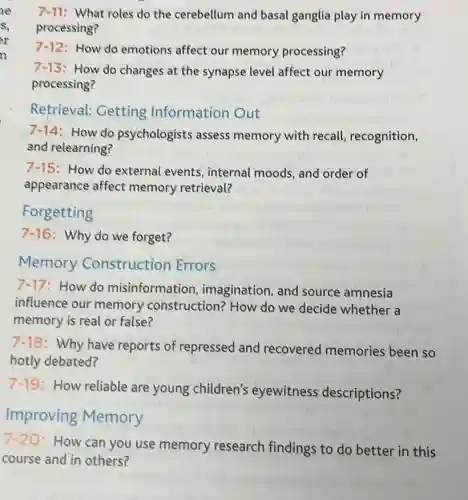
7-11: What roles do the cerebellum and basal ganglia play in memory processing? 7-12: How do emotions affect our memory processing? 7-13 : How do changes at the synapse level affect our memory processing? Retrieval: Getting Information Out 7-14: How do psychologists assess memory with recall recognition, and relearning? 7-15 : How do external events, internal moods and order of appearance affect memory retrieval? Forgetting 7-16 : Why do we forget? Memory Construction Errors 7-17 :How do misinformation imagination, and source amnesia influence our memory construction? How do we decide whether a memory is real or false? 7-18 : Why have reports of repressed and recovered memories been so hotly debated? 7-19 How reliable are young children's eyewitness descriptions? Improving Memory 7-20 How can you use memory research findings to do better in this course and in others?
7-11: What roles do the cerebellum and basal ganglia play in memory
processing?
7-12: How do emotions affect our memory processing?
7-13
: How do changes at the synapse level affect our memory
processing?
Retrieval: Getting Information Out
7-14: How do psychologists assess memory with recall recognition,
and relearning?
7-15 : How do external events, internal moods and order of
appearance affect memory retrieval?
Forgetting
7-16 : Why do we forget?
Memory Construction Errors
7-17 :How do misinformation imagination, and source amnesia
influence our memory construction? How do we decide whether a
memory is real or false?
7-18
: Why have reports of repressed and recovered memories been so
hotly debated?
7-19
How reliable are young children's eyewitness descriptions?
Improving Memory
7-20
How can you use memory research findings to do better in this
course and in others?

Solution
3.7(163 votes)

Answer

1. 7-11: The cerebellum aids in implicit memory, while the basal ganglia help with procedural memory and habits. 2. 7-12: Emotions enhance memory encoding and retrieval via the amygdala. 3. 7-13: Synaptic changes like long-term potentiation strengthen memory. 4. 7-14: Memory is assessed through recall, recognition, and relearning. 5. 7-15: Context, mood, and serial position affect memory retrieval. 6. 7-16: Forgetting arises from encoding failure, decay, or retrieval failure. 7. 7-17: Misinformation, imagination, and source amnesia distort memory. 8. 7-18: Repressed/recovered memories are debated due to suggestibility concerns. 9. 7-19: Young children's eyewitness accounts are less reliable due to suggestibility. 10. 7-20: Use strategies like spaced repetition and active recall to improve memory. Explanation 7-11: The cerebellum and basal ganglia play distinct roles in memory processing. The cerebellum is primarily involved in implicit memory formation, particularly procedural memories like motor skills. The basal ganglia contribute to the formation of habits and procedural memories by processing information related to movement and reward. 7-12: Emotions significantly impact memory processing by enhancing the encoding and retrieval of emotionally charged events. The amygdala, a brain region linked to emotions, interacts with memory-related structures like the hippocampus to strengthen memories associated with strong emotional experiences. 7-13: At the synapse level, changes such as long-term potentiation (LTP) enhance memory processing. LTP strengthens synaptic connections, making it easier for neurons to communicate, which is critical for learning and memory consolidation. 7-14: Psychologists assess memory using recall (retrieving information without cues), recognition (identifying previously learned information), and relearning (measuring the time saved when learning material again). These methods evaluate different aspects of memory retrieval. 7-15: External events, internal moods, and the order of appearance influence memory retrieval through context-dependent memory, state-dependent memory, and the serial position effect. Context and mood can act as retrieval cues, while the serial position effect highlights better recall for items at the beginning (primacy effect) and end (recency effect) of a list. 7-16: Forgetting occurs due to encoding failure, storage decay, or retrieval failure. Encoding failure happens when information is not effectively stored. Storage decay follows the forgetting curve, where unused memories fade over time. Retrieval failure occurs when stored information cannot be accessed due to interference or lack of cues. 7-17: Misinformation, imagination, and source amnesia distort memory construction. Misinformation introduces false details into memory, imagination inflates confidence in false events, and source amnesia confuses the origin of a memory. Deciding whether a memory is real or false involves corroborating evidence and critical evaluation of the memory's source. 7-18: Repressed and recovered memories are debated due to concerns about suggestibility and the reliability of memory retrieval under therapeutic techniques. Critics argue that some recovered memories may be false or influenced by suggestion, while proponents highlight cases of genuine trauma recovery. 7-19: Young children's eyewitness descriptions are less reliable due to their susceptibility to suggestion, leading questions, and difficulty distinguishing real events from imagined ones. Their cognitive and linguistic development also affects the accuracy of their reports. 7-20: Memory research findings can improve academic performance by applying strategies like spaced repetition, active recall, and elaborative rehearsal. Understanding the role of retrieval cues, minimizing interference, and maintaining focus can enhance learning and retention in courses.

Explanation

7-11: The cerebellum and basal ganglia play distinct roles in memory processing. The cerebellum is primarily involved in implicit memory formation, particularly procedural memories like motor skills. The basal ganglia contribute to the formation of habits and procedural memories by processing information related to movement and reward. <br /><br /> 7-12: Emotions significantly impact memory processing by enhancing the encoding and retrieval of emotionally charged events. The amygdala, a brain region linked to emotions, interacts with memory-related structures like the hippocampus to strengthen memories associated with strong emotional experiences. <br /><br /> 7-13: At the synapse level, changes such as long-term potentiation (LTP) enhance memory processing. LTP strengthens synaptic connections, making it easier for neurons to communicate, which is critical for learning and memory consolidation. <br /><br /> 7-14: Psychologists assess memory using recall (retrieving information without cues), recognition (identifying previously learned information), and relearning (measuring the time saved when learning material again). These methods evaluate different aspects of memory retrieval. <br /><br /> 7-15: External events, internal moods, and the order of appearance influence memory retrieval through context-dependent memory, state-dependent memory, and the serial position effect. Context and mood can act as retrieval cues, while the serial position effect highlights better recall for items at the beginning (primacy effect) and end (recency effect) of a list. <br /><br /> 7-16: Forgetting occurs due to encoding failure, storage decay, or retrieval failure. Encoding failure happens when information is not effectively stored. Storage decay follows the forgetting curve, where unused memories fade over time. Retrieval failure occurs when stored information cannot be accessed due to interference or lack of cues. <br /><br /> 7-17: Misinformation, imagination, and source amnesia distort memory construction. Misinformation introduces false details into memory, imagination inflates confidence in false events, and source amnesia confuses the origin of a memory. Deciding whether a memory is real or false involves corroborating evidence and critical evaluation of the memory's source. <br /><br /> 7-18: Repressed and recovered memories are debated due to concerns about suggestibility and the reliability of memory retrieval under therapeutic techniques. Critics argue that some recovered memories may be false or influenced by suggestion, while proponents highlight cases of genuine trauma recovery. <br /><br /> 7-19: Young children's eyewitness descriptions are less reliable due to their susceptibility to suggestion, leading questions, and difficulty distinguishing real events from imagined ones. Their cognitive and linguistic development also affects the accuracy of their reports. <br /><br /> 7-20: Memory research findings can improve academic performance by applying strategies like spaced repetition, active recall, and elaborative rehearsal. Understanding the role of retrieval cues, minimizing interference, and maintaining focus can enhance learning and retention in courses.
Click to rate:

Similar Questions