
QuestionDecember 15, 2025

Plate Tectonics & effects Earthquake Volcano Asteroid Comet Seismograph Epicenter Richter Scale Tsunami Hot Springs Earth's tilt Time Zones in US (How many, names?) Solstice Equinox Weather Climate Global Warming Drought "Math formula for elevation increase Climograph (what two things does it look at?) Marine West Coast Population Pyramid Population Density Rate of Natural Increase
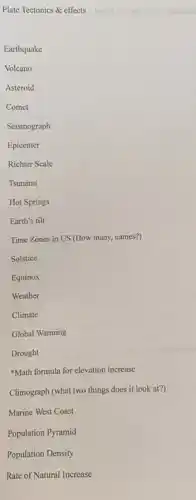
Plate Tectonics & effects Earthquake Volcano Asteroid Comet Seismograph Epicenter Richter Scale Tsunami Hot Springs Earth's tilt Time Zones in US (How many, names?) Solstice Equinox Weather Climate Global Warming Drought "Math formula for elevation increase Climograph (what two things does it look at?) Marine West Coast Population Pyramid Population Density Rate of Natural Increase
Plate Tectonics & effects
Earthquake
Volcano
Asteroid
Comet
Seismograph
Epicenter
Richter Scale
Tsunami
Hot Springs
Earth's tilt
Time Zones in US (How many, names?)
Solstice
Equinox
Weather
Climate
Global Warming
Drought
"Math formula for elevation increase
Climograph (what two things does it look at?)
Marine West Coast
Population Pyramid
Population Density
Rate of Natural Increase

Solution
4.0(137 votes)

Answer

Concise definitions and formulas provided for each term; see steps above for details. Explanation 1. Plate Tectonics & Effects Movement of Earth's plates causes earthquakes, volcanoes, mountain formation, and ocean trench creation. 2. Earthquake Sudden release of energy in Earth's crust causing ground shaking. 3. Volcano Opening in Earth's surface where magma escapes as lava, ash, and gases. 4. Asteroid Rocky object orbiting the Sun, mostly found in asteroid belt; can impact Earth. 5. Comet Icy body with a tail that orbits the Sun; made of dust, rock, and ice. 6. Seismograph Instrument that records earthquake waves. 7. Epicenter Point on Earth's surface directly above earthquake focus. 8. Richter Scale Measures earthquake magnitude using logarithmic scale. 9. Tsunami Large ocean wave caused by underwater earthquake or volcanic eruption. 10. Hot Springs Groundwater heated by geothermal energy rises to surface. 11. Earth's Tilt Earth is tilted at 23.5^\circ, causing seasons. 12. Time Zones in US (How many, names?) Six: Eastern, Central, Mountain, Pacific, Alaska, Hawaii-Aleutian. 13. Solstice Longest/shortest day of year; occurs when sun is farthest from equator. 14. Equinox Day and night are equal length; sun is directly over equator. 15. Weather Short-term atmospheric conditions (temperature, precipitation, etc.). 16. Climate Long-term average weather patterns in an area. 17. Global Warming Increase in Earth's average temperature due to greenhouse gases. 18. Drought Extended period of below-average precipitation. 19. Math formula for elevation increase \text{Elevation Increase} = \text{Ending Elevation} - \text{Starting Elevation} 20. Climograph (what two things does it look at?) Shows temperature and precipitation over time. 21. Marine West Coast Climate with mild temperatures, high rainfall, found near western coasts. 22. Population Pyramid Graph showing age and gender distribution of population. 23. Population Density \text{Population Density} = \frac{\text{Population}}{\text{Area}} 24. Rate of Natural Increase \text{Rate of Natural Increase} = \text{Birth Rate} - \text{Death Rate}

Explanation

1. Plate Tectonics & Effects<br /> Movement of Earth's plates causes earthquakes, volcanoes, mountain formation, and ocean trench creation.<br />2. Earthquake<br /> Sudden release of energy in Earth's crust causing ground shaking.<br />3. Volcano<br /> Opening in Earth's surface where magma escapes as lava, ash, and gases.<br />4. Asteroid<br /> Rocky object orbiting the Sun, mostly found in asteroid belt; can impact Earth.<br />5. Comet<br /> Icy body with a tail that orbits the Sun; made of dust, rock, and ice.<br />6. Seismograph<br /> Instrument that records earthquake waves.<br />7. Epicenter<br /> Point on Earth's surface directly above earthquake focus.<br />8. Richter Scale<br /> Measures earthquake magnitude using logarithmic scale.<br />9. Tsunami<br /> Large ocean wave caused by underwater earthquake or volcanic eruption.<br />10. Hot Springs<br /> Groundwater heated by geothermal energy rises to surface.<br />11. Earth's Tilt<br /> Earth is tilted at $23.5^\circ$, causing seasons.<br />12. Time Zones in US (How many, names?)<br /> Six: Eastern, Central, Mountain, Pacific, Alaska, Hawaii-Aleutian.<br />13. Solstice<br /> Longest/shortest day of year; occurs when sun is farthest from equator.<br />14. Equinox<br /> Day and night are equal length; sun is directly over equator.<br />15. Weather<br /> Short-term atmospheric conditions (temperature, precipitation, etc.).<br />16. Climate<br /> Long-term average weather patterns in an area.<br />17. Global Warming<br /> Increase in Earth's average temperature due to greenhouse gases.<br />18. Drought<br /> Extended period of below-average precipitation.<br />19. Math formula for elevation increase<br /> $ \text{Elevation Increase} = \text{Ending Elevation} - \text{Starting Elevation} $<br />20. Climograph (what two things does it look at?)<br /> Shows temperature and precipitation over time.<br />21. Marine West Coast<br /> Climate with mild temperatures, high rainfall, found near western coasts.<br />22. Population Pyramid<br /> Graph showing age and gender distribution of population.<br />23. Population Density<br /> $ \text{Population Density} = \frac{\text{Population}}{\text{Area}} $<br />24. Rate of Natural Increase<br /> $ \text{Rate of Natural Increase} = \text{Birth Rate} - \text{Death Rate} $
Click to rate:

Similar Questions