


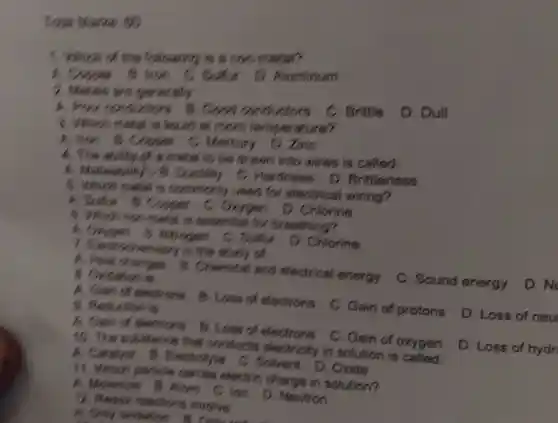
Total Marks as 1. Which of the following is a non-metal? A to kee C. Sulfur D Aluminum 2. Metals are generally C. Brittle D. Dull A. food constictions B. Good conductors 3. Which metal is lioud at room temperature? A. Ikon is Cooper C. Mercury D. Zinc A. This ability of a metal to be drawn into wires is called: A. Mallestality Ductility C.Hardness D Brittleness B. Which motal is commonly r used for electrical wiring? A.Sulfur B.Copper C.Oxygen D.Chlorine C. Which non metal is sssential for breathing? Altrogen C Sulfur D. Chlorine 7 fledrochemistry is ) The study of C. Sound energy D. No A. Heal changes B. Chemical and electrical energy B. Oxidation is D. Loss of neu A. Gain of electrons C. Gain of protons B. Loss of electrons 9. Reduction D. Loss of hydr A. Gain of electrons B Loss of electrons C. Gain of oxygen 10. The substance that conducts electricity in solution is called: A. Catalyst B. Electrolyte C. Solvent D Oxide Which particle cames electric charge in solution? A. Moscule B. Atom C Ion D. Neutron 12. Pedor reactions involve. A. Only oxidation
Solution4.7(332 votes)
Answer
Explanation
Similar Questions
How many atoms of each element are present in each model or formula? $CH_{3}OH$ N ad How many total elements? How many total elements'? How many total elements? What are their names? What are their names? What are their names? How many atoms of each?How many atoms of each? How many atoms of each? How many total atoms? How many total atoms? How many total atoms?
53. Match the abrasive type to the corresponding description of its function or detail. Terms will be used more than once. a. Buffer b. Coarse-grit Abrasive Type Description __ Creates high shine on nail (natural or enhancement) __ Prepares enhancement for a refill/rebalance __ 240 grit or higher __ Should be avoided on freshly applied enhancements __ Removes scratches on nail surface __ A type of buffer __ Used for initial shaping of perimeter of nail __ 100 grit or lower __ Usually comes in two or three-sided form __ Can smooth the enhancement before buffing __ Strong enough to thin enhancement product __ Usually comes in $400;1,000;$ and 4,000 grit __ Can shape the entire nail, as long as product is not too thick __ Shapes free edge of natural nail __ 150 to 180 grit __ Can come in grit ranging from 100 to 400 __ Refines and finishes filling __ After filing is complete, start with low grit and move to higher grit for desired smoothness __ Used for refining overall surface shape of enhancement __ Can create brilliance similar to top coat c. Fine-grit d. Medium-grit e. Shiner
Select the correct answer and then click the Next button. Which of the following is evidence of corrosion? a. Cracking, flaking, or chalking b. Smooth outer surface c. Solid-colored coating paint d. Multi-colored coating paint
You have a balloon containing 1 L of air at STP in a vacuum chamber. What will the volume of the balloon be when you reduce the pressure by half and increase the temperature to 373 K? Use the combined gas law $PV/T=korP_{1}V_{1}/T_{1}=P_{2}V_{2}/T_{2}$ 0.68 L 1.46 L 2.00 L 2.73 L
3. How many moles is $2.80\times 10^{24}$ atoms of silicon?
Which process removes impurities in water most easily? distillation magnetism fractionation chromatography
Which of the following is an example of a chemical change? Color How it looks How it smells How it feels
Partial pressure is the pressure exerted by __ within a mixture of gases. each ges all gases Need help? Review these concept resources.
b. How many particles of $NaClO_{3}$ are needed to produce 68.30 g oxygen? $\underline {\quad }X\underline {\quad }X\underline {\quad }X\underline {\quad }$
Describe the conductivity of the weak acid. The weak acid does show signs of conductivity and slightly illuminates the light. The weak acid does not show signs of conductivity and does not illuminate the light bult.