


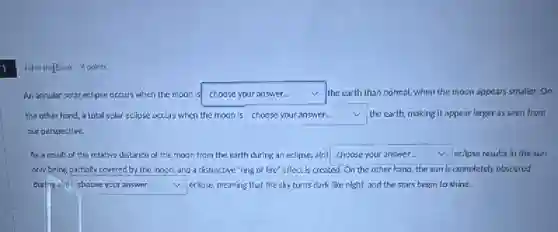
Fill in thefBlank 4 points An annular solar eclipse occurs when the moon is square the earth than normal.when the moon appears smaller.On v the other hand, a lotal solar eclipse occurs when the moon is square the earth, making it appear larger as seen from v our perspective. As a result of the relative distance of the moon from the earth during an eclipse a(n) square eclipse results in the sun only being partially covered by the moon, and a distinctive"ring of fire" effect is created.On the other hand the sun is completely obscured during a(n) square eclipse, meaning that the sky turns dark like night, and the stars begin to shine.
Solution4.6(141 votes)
Answer
Explanation
Similar Questions
Decide which of Newton's Laws are being demonstrated in each example below: 1. You have to wear a seatbelt in the car or you will fly through the windshield in a wreck. __ 2. If you are standing on your skateboard and you throw a ball forwar you roll backward. __ 3. Dropping a bowling ball on the ground makes a louder sound than dropping a tennis ball. __ 4. If an astronaut loses a tool in space, it will continue to move awa her without slowing down. __
Series Circuits: Calculating Voltage Resistance and Current 10/27/25 Resistors is Electric cosytes 8. Current for Seri Copy link $R_{1}=5\Omega $ 1. Total voltage gain $R_{3}=7\Omega $ $V_{T}=12V$ w 2. Equivalent resistance $R_{T}=R_{1}+R_{2}+R_{3}$ videos Combination nation Circuits Voltage Adding Resistors Adding Resistors Resistance MULTIPLE-CHOICE QUESTION What is the total or equivalent resistance of this circuit? $12\Omega $ $21\Omega $ $33\Omega $
Part D What is meant by a "chain reaction"? $\square $ $\square $ Space used (includes formatting): 0/30000
In a parallel circuit containing two unequal resistors, the voltage potential will be $\square $ . equal
A star spends most of its life in this stage: White dwarf Red giant Protostar Main sequence
What Is gravity? At this moment you are exerting an attractive force on everything around you-your desk, your classmates, and even the planet Jupiter, millions of kilometers away. This attractive force acts on all object with mass and is called gravity. Gravity. is an attractive force between any two objects that depends on the masses of the objects and the distance between them. Gravity increases as the mass of either object increases, or as the objects move closer to each other. You can't feel the force between you and your desk because the force is weak. Earth is both close and has a large enough mass that you can feel its gravitational attraction. The Sun has more mass, but it is too far away to exert an attraction you can feel. a a a If the mass of either of the objects If the objects are closer together, increases, the gravitational force the gravitational force between between them increases. them increases. Picture This 7. Interpret Illustrations What two things can cause the gravitational force between objects to increase? __ Reading Essentials 43
What is the identity of planet A? $\square $ What is the identity of planet B? $\square $
Step 3:Calculate the Predicted Change in Kinetic Energy Calculate the change in the kinetic energy $(KE)$ of the bottle when the mass is increased. Use the formula is the mass and v is the speed (velocity). Assume that the speed of the soda bottle falling 0.8 m will be 4 m/s,and use this speed for each Record your calculations in Table A of your Student When the mass of the bottle is 0.125 kg the KE is $\square kg\cdot m^{2}/s^{2}$ When the mass of the bottle is 0250 kg, the KE is $\square kg\cdot m^{2}/s^{2}.$ When the mass of the bottle is 0.375 kg, the KE is $\square kg\cdot m^{2}/s^{2}$ When the mass of the bottle is 0500 kg, the KE is $\square kg\cdot m^{2}/s^{2}$
Complete the statements. During beta minus decay, a nucleus emits a(n) $\square $ and a(n) $\square $ During beta plus decay, a nucleus efinits a(n) $\square $ and a(n) $\square $
Are sound and heat forms of energy? No Yes