


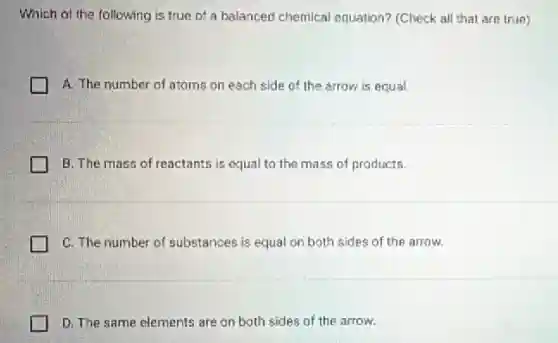
Which of the following is true of a balanced chemical equation?(Check all that are true) A. The number of atoms on each side of the arrow is equal B. The mass of reactants is equal to the mass of products. C. The number of substances is equal on both sides of the arrow. D. The same elements are on both sides of the arrow.
Solution4.4(401 votes)
Answer
Explanation
Similar Questions
Calculate the molar masses of the following chemical compounds. 1) NaBr 2) AgF 3) $(NH_{4})_{2}S$ 4) $PbSO_{4}$ 5) $C_{6}H_{12}O_{6}$ 6) $Ca(OH)_{2}$ 7) KOH 8) $Mg(OH)_{2}$
Which statement about reaction rates is accurate? All chemical reactions occur at different rates. All chemical reactions occur at a fast rate. All chemical reactions occur at the same rate. All chemical reactions occur at a slow rate.
The atomic mass of Lithium is 6.94. This means, the mass number of Lithium is 6. True False
How does a catalyst speed up a chemical reaction? A. by lowering the activation energy B. by lowering the AH of the reaction C. by raising the energy of the products D. by raising the energy of the reactants
Anton's homework assignment is to make a banana undergo a chemical change Which of the following should he do to complete his assignment correctly? peel the banana mash the banana slice the banana into small pieces leave the banana out for a week to rot
22. In an endothermic reaction, the temperature of the surroundings: Decreases Increases Stays Constant Becomes radioactive
What is the correct definition of solute what dissolves the solute what gets dissolved a homogenous mixture
18. Relates the moles of a gas with its volume, temperature and pressure Boyle's Law Charles' Law Ideal Gas Law Combined Gas Law Dalton's Law of Partial Pressure
How many grams are in $7.91\times 10^{21}$ atoms of Scandium?
What is the expression of the chemical composition of a compound? electron arrangement chemical formula element formula bond arrangement