


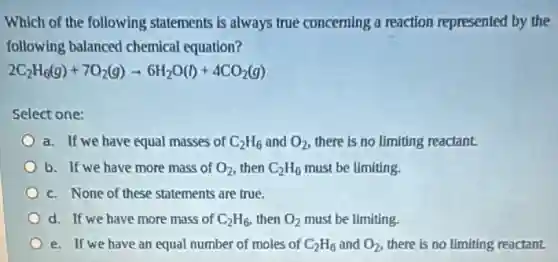
Which of the following statements is always true concerning a reaction represented by the following balanced chemical equation? 2C_(2)H_(6)(g)+7O_(2)(g)arrow 6H_(2)O(l)+4CO_(2)(g) Select one: a. If we have equal masses of C_(2)H_(6) and O_(2) there is no limiting reactant. b. If we have more mass of O_(2) then C_(2)H_(6) must be limiting. c. None of these statements are true. d. If we have more mass of C_(2)H_(6) then O_(2) must be limiting. e. If we have an equal number of moles of C_(2)H_(6) and O_(2) there is no limiting reactant.
Solution4.5(159 votes)
Answer
Explanation
Similar Questions
Which atoms will bond when valence electrons are transferred I from one to another? and Se and Sr 0 and P and H
A solution is made with 100 milliliters of water, how much solute will dissolve if 200 milliliters is used by the student at the next table? Half as much solid can dissolve in the 200 mL One-fourth as much solid can dissolve in the 200 mL Twice as much solute can dissolve in 200 mL The same amount will dissolve in 200 mL as what dissolved in 100 mL
Which of the following represents a covalent molecule? SELECT ALL THAT APPLY a $CO_{2}$ b $Cl_{2}$ C He d $O_{2}$
Div 5. Calculate the number of moles in 18.0 g of sodium chloride (NaCl). 0.31 mole 1044 moles 3.2 moles 18 moles
Which noble gas does not possess a true octet? a helium b xenon c radon d argon
When the following equation is balanced, what is the sum of the coefficients? $\underline {\quad }C_{2}H_{4}+\underline {\quad }O_{2}\rightarrow \underline {\quad }CO_{2}+\underline {\quad }H_{2}O$ 11 7 6 8
Rost Lab: Single-Replacement Reactions occur when a more reactive element displaces a less reactive element compound. There is a table on the back of your periodic table labeled "Activity Series". Higher elements are more elements on the table In other words elements higher on the Activity series will replace elements lower in the seri elements will not replace higher elements. The speed and energy of the reaction is directly proportional to the dis two elements on the series. 3. Balance the following equations. a. $\underline {\quad }F_{2}+\underline {\quad }NaCl\rightarrow \underline {\quad }Cl_{2}+\underline {\quad }NaF$ b. $\underline {\quad }Li+\underline {\quad }MgCO_{3}\rightarrow \underline {\quad }Mg+\underline {\quad }Li_{2}CO_{3}$ c. $\underline {\quad }K\quad +\underline {\quad }Al(OH)_{3}\rightarrow \underline {\quad }Al\quad +\underline {\quad }KOH$ d. $\underline {\quad }Br_{2}+\underline {\quad }CaCl_{2}\rightarrow \underline {\quad }Cl_{2}+\underline {\quad }CaBr_{2}$ e. $\underline {\quad }Zn+\underline {\quad }Cu_{3}(PO_{4})2\rightarrow \underline {\quad }Cu+\underline {\quad }Zn_{3}(PO_{4})_{2}$
Predict the products of the reaction below $Mg+Cu(NO_{3})_{2}\rightarrow \underline {\quad }+\underline {\quad }$ $Cu+Mg(NO_{3})_{2}$ $Cu+MgNO_{3}$ $CuMg+NO_{3}$ $Mg_{2}NO_{3}+Cu$
A chemical substance that is present at the start of a chemical reaction Exothermic Enzyme activation energy Reactant
A solution contains 803.92 milligrams of glucose per 100 ml sample. The molar mass of glucose is $180.15g/mol$ What is the molarity of glucose in the sample? $\square $