


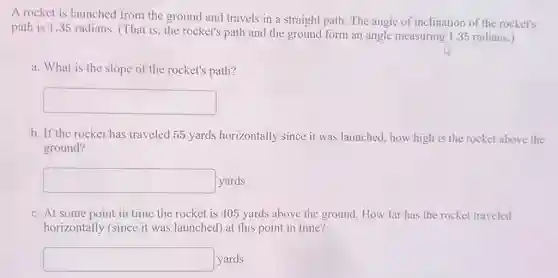
A rocket is launched from the ground and travels in a straight path. The angle of inclination of the rocket's path is 1.35 radians (That is, the rocket's path and the ground form an angle measuring 1.35 radians.) a. What is the slope of the rocket's path? square b. If the rocket has traveled 55 yards horizontally since it was launched, how high is the rocket above the ground? square yards c. At some point in time the rocket is 405 yards above the ground. How far has the rocket traveled horizontally (since it was launched) at this point in time? square yards
Solution4.2(264 votes)
Answer
Explanation
Similar Questions
How much heat is needed to change the temperature of 3 grams of gold $(c=0.129\frac {1}{g^{\circ }C})$ from $21^{\circ }C$ to $363^{\circ }C$ ? The answer is expressed to the nearest whole number. 121 joules 132 joules 140 joules 149 joules
Fire the catapult at the lowest cup position What is the distance achieved? About 635 About 357
If Jerome is swinging on a rope and transferring energy from gravitational potential energy to kinetic energy, what is being done? compression work radiation energy creation
Which word or phrase best describes entropy? disorder order kinetic energy force
What are most semiconductors made from? aluminum copper iron silicon
At which temperature does all molecular motion stop? OR $0^{\circ }C$ OK $0^{\circ }F$
Which statement about the volume and pressure of a gas is the most accurate? Volume of a gas is directly proportional to pressure of that gas in any container. Volume of a gas is inversely proportional to pressure of that gas in any container. Volume of a gas is always greater than pressure of that gas in any container. Volume of a gas is equal to pressure of that gas in any container.
CER: Make a claim about which type of material (dark or light)increases in temperature more when exposed to light energy Use evidence and scientific reasoning from class to support your answer. Your answer
In a transverse wave the wavelength can be measured as the distance between two adjacent compressions. TRUE FALSE
The slope of a linear velocity vs time graph tells us the __ of the object. displacement velocity speed acceleration