


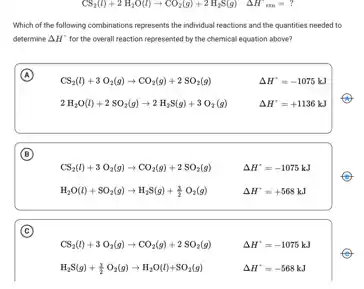
CS_(2)(l)+2H_(2)O(l)arrow CO_(2)(g)+2H_(2)S(g) Delta H^circ _(rxn)=? Which of the following combinations represents the individual reactions and the quantities needed to determine Delta H' for the overall reaction represented by the chemical equation above? A CS_(2)(l)+3O_(2)(g)arrow CO_(2)(g)+2SO_(2)(g) Delta H^+=-1075kJ 2H_(2)O(l)+2SO_(2)(g)arrow 2H_(2)S(g)+3O_(2)(g) Delta H^+=+1136kJ B CS_(2)(l)+3O_(2)(g)arrow CO_(2)(g)+2SO_(2)(g) H_(2)O(l)+SO_(2)(g)arrow H_(2)S(g)+(3)/(2)O_(2)(g) Delta H^+=-1075kJ Delta H^+=+568kJ (C) CS_(2)(l)+3O_(2)(g)arrow CO_(2)(g)+2SO_(2)(g) Delta H^+=-1075kJ Delta H^+=-568kJ
Solution4.4(154 votes)
Answer
Explanation
Similar Questions
R-134a is the same as: A. CFC-134b B. HFC-134b C. HFC-134a D. HFO-13 aa
vo groups of students conducted the same experiment to determine how quickly salt dissolves in water at different temperatures. Both groups used identical materials and procedures but collected slightly terent data. What should the students do next to increase the reliability of their results? Change their hypothesis to fit the first group's data Use different solutes to get a wider range of data. Average both groups' data and move on to a new topic. Repeat the experiment and compare results again.
15. Which is the most common type of synthetic polymer? polyester C hormones rubber polyethylene
15. An atom has 17 protons, 16 neutrons and 17 electrons. What is its atomic mass? A. 17 amu B. 33 amu C. 34 amu D. 57 amu
8.1 A chemist performs the following reaction to make sodium nitrate: $2NaNO_{2}(s)+O_{2}(g)\rightarrow 2NaNO_{3}(s)$ How many moles of oxygen gas must the chemist use to make 45.0 moles of $NaNO_{3}$ How many moles of $NaNO_{2}$ are necessary?
Are chemical hazards always visible? Select the best option. Yes No If you need to review this content, it can be found in the Chemical Hazards module of the Industrial Hygiene topic.
__ 21. In chemistry, there is a law called the Ideal Gas Law that says: The volume of a gas varies directly as the temperature (T) and the number of moles (n), and inversely as the pressure $(P).$ In the Ideal Gas Law, the letter r is used as the constant (instead of k). Find the value of r if the volume of 1 mole of a gas is 22.4 liters when the pressure is 1 atmosphere and the temperature is 273 Kelvin.
A gas sample has a volume of 4.5 L at a pressure of 2.0 atm. If the pressure is increased to 6.0 atm while keeping temperature constant, what is the new volume?
2. How many formula units are in 150 grams of Sodium Chloride (NaCl)?
Which of the examples below represents a physical change? a nail rusting an ice cube melting an apple decomposing a piece of toast burning