


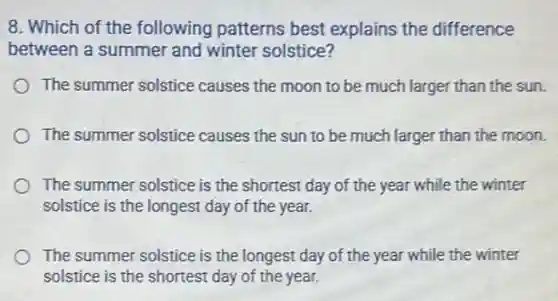
8. Which of the following patterns best explains the difference between a summer and winter solstice? The summer solstice causes the moon to be much larger than the sun. The summer solstice causes the sun to be much larger than the moon. The summer solstice is the shortest day of the year while the winter solstice is the longest day of the year. The summer solstice is the longest day of the year while the winter solstice is the shortest day of the year.
Solution4.5(284 votes)
Answer
Explanation
Similar Questions
Which location has the trail Owl Canyon? Lake Mead Red Rock Mount Charleston
Which of these can determine the size of grains in igneous rocks? Amount of rare minerals Distance from a plate boundary Size of the volcano Cooling rate of molten rock
Which two of the following best describe what events led to ore deposits in the Earth. A Hydrothermal activities B Rain shadow effects Solar eruptions D Tidal waves E Volcanoes
Largest East Asian country by land area? A) Mongolia B) Japan C) China D) South Korea
The majority of Egypt's population is clustered around what geographical feature? The Gulf of Suez The Suez Canal The Western Desert The Nile River
Climatic regions are classified according to temperature and __ Which phrase best completes the sentence? altitude ocean currents distance from bodies of water precipitation
Which best describes El Salvador? (1 point) small mountainous small, Caribbean coastline large European population largest of the Central American countries
Where does the Mid -Atlantic Ridge rise above sea level? a. The Hawaiian Islands b. Iceland c. South Africa d. Coastal Brazil
Which of the following types of volcanoes is MOST likely to form within another, larger volcano? a. Shield volcanoes b. Cinder cones c. Stratovolcanoes d. Lava domes
Which location has the trail Mary Jane Falls? Red Rock Lake Mead Mount Charleston