


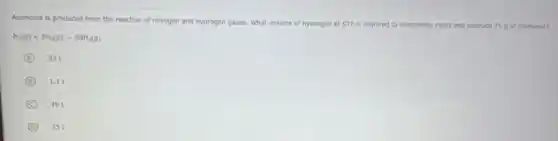
Ammonia is produced from the reaction of nitrogen and hydrogen gases. What volume of hydrogen at STP is required to completely react and produce 25 of ammonia? N_(2)(g)+3H_(2)(g)-2NH_(3)(g) A 33 B 1.1 L C 491 D 251
Solution4.5(219 votes)
Answer
Explanation
Similar Questions
5. On a drawing a proton is shown with the symbol __ ? $(-)$ (0) $(+)$
6. Moles to Liters:What is the volume , in liters, of 0.0350 moles of Nitrogen dioxide gas $(NO_{2})$ at STP? $\square $
This question has two parts. First, answer Part A. Then answer Part B. You must answer Part A correctly in order to get credit for answering Part B correctly. Part A : Below is an equation showing that thydrogen peroxide can break down into water and oxygen. Determine what coefficients are missing in this chemical equation. Enter the correct numerical answers in the boxes. $2H_{2}O_{2}\rightarrow \square H_{2}O+\square O_{2}$ Part B: Using the equation from Part A, answer Part B. Complete the statement by selecting the appropriate answer. The type of reaction that occurs when one reactant breaks down inte two or more products is called a __ reaction A synthesis B single replacement C decomposition D combustion
NaCl dissolved in water.forming a solution . What is the van't Hoff factor for NaCl? $van't\quad Hoff\quad factor=[?]$
Chemical equations must be balanced to satisfy A Avogadro's principle B the law of multiple proportions C the law of conservation of mass D the law of definite proportions
The gain or loss of an electron is termed: Ionization Cation Anion Radiation
According to the postulates of the kinetic molecular theory, which variable is directly proportional to the kinetic energy of gas molecules? A Pressure B Temperature C Volume D Moles
3. Apart from making life difficult for beginning chemistry students, why do chemists refer to $CO_{2}$ as carbon dioxide, yet use the name tin $(IV)$ oxide to describe $SnO_{2}$
Which statement about covalent compounds is FALSE? a Covalent compounds . can contain as little as 2 atoms or as many as several thousand atoms. Covalent compounds can b contain a maximum of 4 different atoms. Covalent compounds , are C held together by covalent bonds. d Covalent compounds contain only nonmetals.
According to the Michaelis Menten equation. when the substrate concentration $(TSD)$ is rqual to the Michaelie Conatant (Km)), the reaction veforthy (v) is epproximately. Answers:A. D A Vmax B $2^{4}vmax$ C $0.5Vmax$ D $0.1Vmax$