
QuestionApril 21, 2026

Learning GOAL You will analyze glacial features in Glacier National Park and make inferences about repional climate. You will predict how the glaciers there might change in the future. Refer to the map of Glacier National Park in Fig.14.14 A List the features of glaciation from Figs.14.3-14.10 that you can observe in Fig.14.14 Locate Quartz Lake and Middle Quartz Lake in the southwest part of the map. Notice the patrol cabin located between these lakes. Infer the chain of geologic/glacial events (steps)that led to formation of Quartz Lake, the valley of Quartz Lake.the small piece of land on which the patrol cabin is located, and the cirque in which Rainbow Glacier is located today C Based on your answers in parts A and B. what kind of glaciation (mountain versus continental) has shaped this landscape? D Locate the continental divide on Fig.14.14 and recall that it divides surface water that flows west into the Pacific Ocean from water that flows east into the Atlantic Ocean or Gulf of Mexico Think of ways that the continental divide may be related to weather and climate in the region. Recall that weather systems generally move across the United States from west to east. 1. Describe how modem glaciers of this region are distributed in relation to the Continental Divide. 2. Based on the distribution you observed, describe the weathericlimate conditions that may exist on opposite sides of the Continental Divide in this region. 3. Look at the location of glaciers in this map area in relation to ridges and mountain peaks. On which vide(s) of the ridges and mountain peaks do the glaciers tend to be located (C.g., north, south east, west, or some combination)? Suggest at least one explanation for this observation. E Using the data table in Fig14.14 describe how the area of Agassiz Glacier changed from 1850 to 2015.Agassiz Glacier is in the northwest part of the map. F Describe how the area of Vulture Glacier changed from 1850 to 2015, Vulture Glacier is in the southeast part of the map. 2030? G REFLECT 8.DISCUSS Whil do you expect the area (km^2) of Agassiz and Vulture Glaciers to be in 2030 Explain.
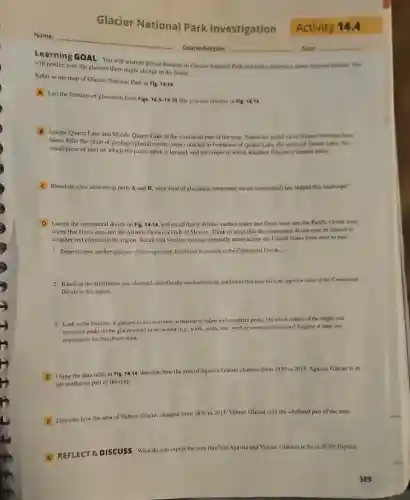
Learning GOAL You will analyze glacial features in Glacier National Park and make inferences about repional climate. You will predict how the glaciers there might change in the future. Refer to the map of Glacier National Park in Fig.14.14 A List the features of glaciation from Figs.14.3-14.10 that you can observe in Fig.14.14 Locate Quartz Lake and Middle Quartz Lake in the southwest part of the map. Notice the patrol cabin located between these lakes. Infer the chain of geologic/glacial events (steps)that led to formation of Quartz Lake, the valley of Quartz Lake.the small piece of land on which the patrol cabin is located, and the cirque in which Rainbow Glacier is located today C Based on your answers in parts A and B. what kind of glaciation (mountain versus continental) has shaped this landscape? D Locate the continental divide on Fig.14.14 and recall that it divides surface water that flows west into the Pacific Ocean from water that flows east into the Atlantic Ocean or Gulf of Mexico Think of ways that the continental divide may be related to weather and climate in the region. Recall that weather systems generally move across the United States from west to east. 1. Describe how modem glaciers of this region are distributed in relation to the Continental Divide. 2. Based on the distribution you observed, describe the weathericlimate conditions that may exist on opposite sides of the Continental Divide in this region. 3. Look at the location of glaciers in this map area in relation to ridges and mountain peaks. On which vide(s) of the ridges and mountain peaks do the glaciers tend to be located (C.g., north, south east, west, or some combination)? Suggest at least one explanation for this observation. E Using the data table in Fig14.14 describe how the area of Agassiz Glacier changed from 1850 to 2015.Agassiz Glacier is in the northwest part of the map. F Describe how the area of Vulture Glacier changed from 1850 to 2015, Vulture Glacier is in the southeast part of the map. 2030? G REFLECT 8.DISCUSS Whil do you expect the area (km^2) of Agassiz and Vulture Glaciers to be in 2030 Explain.
Learning GOAL You will analyze glacial features in Glacier National Park and make inferences about repional climate. You
will predict how the glaciers there might change in the future.
Refer to the map of Glacier National Park in
Fig.14.14
A List the features of glaciation from
Figs.14.3-14.10 that you can observe in Fig.14.14
Locate Quartz Lake and Middle Quartz Lake in the southwest part of the map. Notice the patrol cabin located between these
lakes. Infer the chain of geologic/glacial events (steps)that led to formation of Quartz Lake, the valley of Quartz Lake.the
small piece of land on which the patrol cabin is located, and the cirque in which Rainbow Glacier is located today
C Based on your answers in parts A and B. what kind of glaciation (mountain versus continental) has shaped this landscape?
D Locate the continental divide on Fig.14.14 and recall that it divides surface water that flows west into the Pacific Ocean from
water that flows east into the Atlantic Ocean or Gulf of Mexico Think of ways that the continental divide may be related to
weather and climate in the region. Recall that weather systems generally move across the United States from west to east.
1. Describe how modem glaciers of this region are distributed in relation to the Continental Divide.
2. Based on the distribution you observed, describe the weathericlimate conditions that may exist on opposite sides of the Continental
Divide in this region.
3. Look at the location of glaciers in this map area in relation to ridges and mountain peaks. On which vide(s) of the ridges and
mountain peaks do the glaciers tend to be located (C.g., north, south east, west, or some combination)? Suggest at least one
explanation for this observation.
E Using the data table in Fig14.14
describe how the area of Agassiz Glacier changed from 1850 to 2015.Agassiz Glacier is in
the northwest part of the map.
F
Describe how the area of Vulture Glacier changed from 1850 to 2015, Vulture Glacier is in the southeast part of the map.
2030?
G
REFLECT 8.DISCUSS Whil do you expect the area
(km^2) of Agassiz and Vulture Glaciers to be in 2030 Explain.

Solution
4.6(213 votes)

Answer

Agassiz and Vulture Glaciers are expected to continue decreasing in area by 2030 due to ongoing climate change. Explanation 1. Identify Glacial Features Observe features such as cirques, arêtes, horns, and moraines in Fig. 14.14, as referenced from Figs. 14.3-14.10. 2. Infer Geologic Events Quartz Lake and its valley likely formed from glacial carving. The patrol cabin's land is a moraine or glacial deposit. Rainbow Glacier's cirque indicates past glacial erosion. 3. Determine Type of Glaciation The landscape is shaped by mountain glaciation, evident from the presence of cirques and sharp ridges. 4. Analyze Continental Divide's Influence Glaciers are distributed along the Continental Divide, affecting weather patterns by creating orographic precipitation on the windward side and drier conditions leeward. 5. Assess Glacier Distribution Glaciers are often on north-facing slopes due to less sun exposure, preserving ice longer. This is common in mountainous regions. 6. Evaluate Agassiz Glacier Changes Agassiz Glacier's area decreased significantly from 1850 to 2015, indicating retreat due to warming temperatures. 7. Evaluate Vulture Glacier Changes Vulture Glacier also shrank from 1850 to 2015, showing similar retreat patterns as Agassiz Glacier. 8. Predict Future Glacier Areas Both glaciers are expected to continue shrinking by 2030 due to ongoing climate warming, potentially reducing their areas further.

Explanation

1. Identify Glacial Features<br /> Observe features such as cirques, arêtes, horns, and moraines in Fig. 14.14, as referenced from Figs. 14.3-14.10.<br /><br />2. Infer Geologic Events<br /> Quartz Lake and its valley likely formed from glacial carving. The patrol cabin's land is a moraine or glacial deposit. Rainbow Glacier's cirque indicates past glacial erosion.<br /><br />3. Determine Type of Glaciation<br /> The landscape is shaped by mountain glaciation, evident from the presence of cirques and sharp ridges.<br /><br />4. Analyze Continental Divide's Influence<br /> Glaciers are distributed along the Continental Divide, affecting weather patterns by creating orographic precipitation on the windward side and drier conditions leeward.<br /><br />5. Assess Glacier Distribution<br /> Glaciers are often on north-facing slopes due to less sun exposure, preserving ice longer. This is common in mountainous regions.<br /><br />6. Evaluate Agassiz Glacier Changes<br /> Agassiz Glacier's area decreased significantly from 1850 to 2015, indicating retreat due to warming temperatures.<br /><br />7. Evaluate Vulture Glacier Changes<br /> Vulture Glacier also shrank from 1850 to 2015, showing similar retreat patterns as Agassiz Glacier.<br /><br />8. Predict Future Glacier Areas<br /> Both glaciers are expected to continue shrinking by 2030 due to ongoing climate warming, potentially reducing their areas further.
Click to rate: