


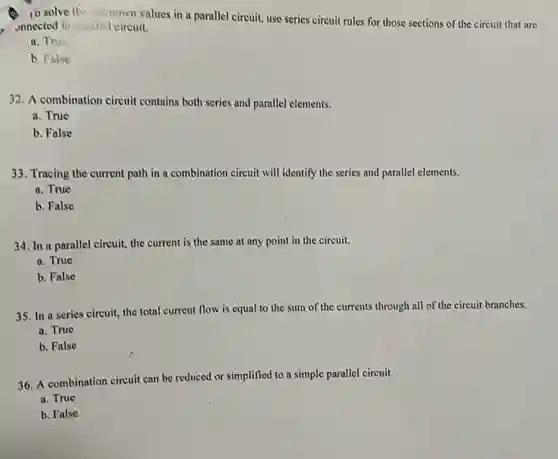
ib solve the intown values in a parallel circuit, use series circuit rules for those sections of the circuit that are onnected in pusitel circuit. a. This b. False 32. A combination circuit contains both series and parallel elements. a. True b. False 33. Tracing the current path in a combination circuit will identify the series and parallel elements. a. True b. False 34. In a parallel circuit, the current is the same at any point in the circuit. a. True b. False 35. In a series circuit, the total current flow is equal to the sum of the currents through all of the circuit branches. a. True b. False 36. A combination circuit can be reduced or simplified to a simple parallel circuit. a. True b. False
Solution4.7(286 votes)
Answer
Explanation
Similar Questions
(E) MULTIPLE-CHOICE QUESTION What was the MAIN reason this trial failed? The concrete filling was too dense. They did not use a steel center for the wrecking balls. The frame moved and absorbed most of the energy.
Which process melts an ore to separate useful metals from the rest of the elements in the ore? smelting mining prospecting alloys
Which type of mine may be used to remove coal from a coal seam deep underground? open pit mine strip mine subsurface mine underwater mine
(1) How do self-driving cars travel safely on the streets? Sensors and cameras help self-driving cars $\square $ and $\square $ on the road.
An all wheel drive vehicle increases traction and allows the driver to better manage the vehicle in inclement weather. True False
Which is a likely reason a jacket might contain interfacing? to help it keep its shape to avoid the need for dry cleaning to make the garment easier to construct to absorb odors
The biggest maintenance problem in pneumatic systems is __ Rusted components Noisy components Overheating Air leakage
Never stand directly behind the saw blade. True False
Q7: On right side pistons the arrow on the top of the piston and the dimple on the rod __ and on left side pistons the arrow on the top of the piston and the dimple on the rod __ A. are on opposite sides / are on the same side B. face the outside of the engine/ face the inside of the engine C. face the same direction/ are on opposite sides D. face the inside of the engine/ face the outside of the engine
Technician A says that if the vehicle battery is below 12.4 volts when testing with a voltmeter it should be charged with a smart battery charger . Technician B says that correct tire readings ; are listed on a placard on the driver's side door frame. Who is correct? A) Technician A only B) Technician B only C) Both Technician A and B D) Neither Technician A nor B