


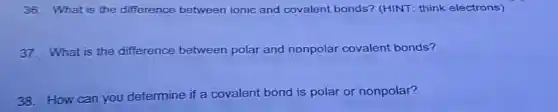
36. What is the difference between ionic and covalent bonds?(HINT: think electrons) 37. What is the difference between polar and nonpolar covalent bonds? 38. How can you determine if a covalent bond is polar or nonpolar?
Solution4.2(284 votes)
Answer
Explanation
Similar Questions
Which tests were useful in determining whether or not a compound was ionic or covalent? (Select more than one!!) Brittleness D Conductivity Water Solubility Melting Point
Determine if the elements in the following compounds are metals or non-metals Describe the type of bonding that occurs in the compound/ Determine si los elementos en los siguientes compuestos son metales o no metales. Describe el tipo de enlace que ocurre en el compuesto REMEMBER... Ionic Bond Covalent Bond between a Metal and Non-Metal between a Non-Metal and Non-Metal $(M+NM)$ $(NM+NM)$ Compound 1. CO2 Element 1 (metal or non-metal? $\square $ Element 2 (metal or non-metal? $\square $ Bond Type (Tipo de Enlace) $\square $
19. Complete and balance the following equation, if a reaction occurs: $Na_{2}CO_{3}(aq)+HCl(aq)\rightarrow ?$ Write only the products for the answer. Balance the equation before you plug in the answer. Do not forget to write coefficients for the products. Typearesponse
How is a mixture of carbon and oxygen different from a compound of carbon dioxide? Give examples of a liquid dissolved in a liquid: Gas dissolved in a liquid Solid dissolved in a liquid Is permanent ink soluble in water?Explain.
Which of the following is an example of a chemical process? cutting a piece of wood into small wood chips burning a marshmallow dissolving table salt in a glass of water boiling water turning into steam
The decomposition of $NH_{4}HS$ is an endothermic reaction $1NH_{4}HS(s)\rightleftharpoons 1NH_{3}(g)+1H_{2}S(g)$ Which change to this reaction will increase the concentration $H_{2}S$ , Adecrease in the volume at a constant temperature (decrease in the concentration of $NH_{4}HS$ An increase in temperature none of the above
Which statements are true concerning covalent bonds? Select TWO correct answers. Covalent bonds form between metals and nonmetals. Covalently bonded compounds have high melting and boiling points. Covalent bonds form through the donation of electrons. Covalently bonded compounds usually have low melting and boiling points. Covalent bonds form between two nonmetals.
What is the molecular shape of carbon dioxide? Trigonal Planar Bent Tetrahedral Linear
39. Optional extra credit: Cakulate the number of Nitrogen atoms in the copper nitrate compound produced when 3 moles of copper (s) reacts with excess nitric acid
What is the shape of a methone molecule according to VSEPR theory? Bent Tetrahedral Trigonal Planar Linear