


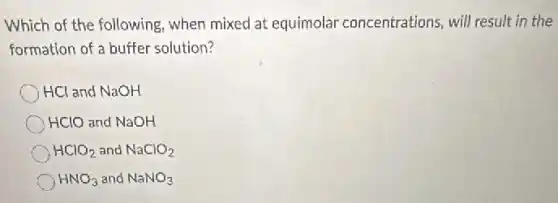
Which of the following when mixed at equimolar concentrations, will result in the formation of a buffer solution? HCl and NaOH HClO and NaOH HClO_(2) and NaClO_(2) HNO_(3) and NaNO_(3)
Solution4.4(299 votes)
Answer
Explanation
Similar Questions
According to Bonsted-Lowery theory, acid base reactions can be considered as proton transfer reactions. A True B False
How many unpair electrons are in an atom of Co in its ground state? 7 1 0 3
6. How many mols of $CO_{2}$ are formed with 4.87 grams of baking soda? Click on the letter in the formula to insert a number. $[A]x\frac {[A]}{[A]}\times \frac {[C]}{[D]}\times \frac {[D]}{[C]}=$
Fire is rapid oxidation, and an explosion is __ A) Always illegal B) Important C) A very rapid fire D) Unavoidable
15. What is the concentration of HCl $(M)$ in water if the solution is $36.0\% $ HCl by mass and has a density of $1.18g/mL$ A. 0.116 M B. 0.360 M C. 8.25 M D. 11.6 M E. 36.0 M
Which pair has the same empirical formula? $CH_{4}$ and $C_{2}H_{6}$ $NaCrO_{4}$ and $Na_{2}Cr_{2}O_{7}$ $C_{3}H_{6}O_{3}$ and $C_{2}H_{6}O_{2}$ $C_{2}H_{4}O_{2}$ and $C_{6}H_{12}O_{6}$
The hybrid orbital set used by the central atom in $NCl_{3}$ is __ sp3 sp sp2 sp3d sp3d2
c. If a bronze statue grows darker in color over time, what color do you think tin oxide (SnO) is?
Multiple Choice 2 points A chemical reaction in which a larger molecule is built from smaller molecules is a(n) catabolic reaction. C synthesis reaction. exchange reaction. decomposition reaction.
e. How many molecules are in 48.0 grams of NaOH? f. How many grams are in $4.63\times 10^{24}$ moles of $CCl_{4}$