


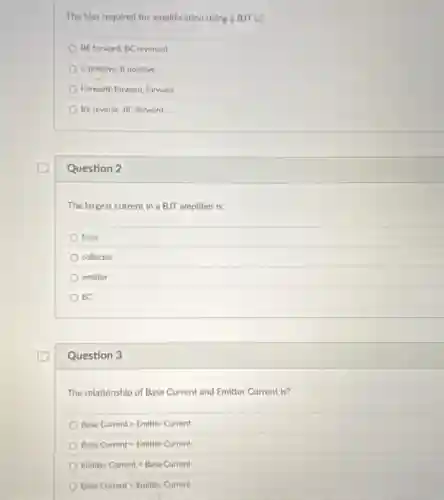
The bias required for amplification using a BJT is? BE forward, BC reversed C positive, B positive Fonward, forward, forward BE reverse, BC forward Question 2 The largest current in a BJT amplifier is: base collector emitter EC Question 3 The relationship of Base Current and Emitter Current is? Base Currentgt Emitter Current Base Current=Emitter Current Emitter Currentlt Base Current Base Currentlt Emitter Current
Solution4.4(282 votes)
Answer
Explanation
Similar Questions
What will happen if the pump flow output of a positive displacement pump gets blocked? Select one: a. A serious pump failure will occur. b. The prime mover keeps turning. c. The pump is not affected. d. There will be lower efficiency.
Technician A says one of the common pump tests is called the zero swashplate calibration. Technician B says as a pump's internal leakage increases, its efficiency increases. Who is correct? Select one: a. Technician A b. Technician B c. Both A and B d. Neither Anor B
Alignment Inspection Exercise Follow the instructions in the animation and interact with the controls to answer the question. Click for Animation What is the measured value of the right front $(RF)$ caster? a. $-0.5^{\circ }$ b. $+0.5^{\circ }$ C. $-1.85^{\circ }$ d. $-1.95^{\circ }$
Alignment Inspection Exercise Follow the instructions in the animation and interact with the controls to answer the question. Click for Animation What is the measured value of the RF toe? a. $-0.10^{\circ }$ b. $0^{\circ }$ C. $+0.1^{\circ }$ d. $+0.06^{\circ }$
Tech A says seal failure in a directional control valve can be caused by overheated oil. Tech B says an electric coil can fail but not affect valve actuation Who is correct? Select one: a. Tech A b. Tech B c. Both Tech A and Tech B d. Neither Tech A nor Tech B
Tubing benders are used to bend: Answer A. soft copper only. B. hard copper only. C. both soft and hard copper. D. annealed copper.
The main purposes of hydraulic valves that are used in a machine's hydraulic system are to manage all the following EXCEPT for the Select one: a. pressure b. flow c. temperature d. direction
Technician A says pump displacement can be calculated to give a value of either gallons per minute or liters per minute. Technician B says most pumps produce roughly I gallon of flow per revolution. Who is correct? Select one: a. Technician A b. Technician B c. Both A and B d. Neither Anor B
Tech A says closing the restriction valve on a flow meter will increase pump output pressure. Tech B says oil temperature won't have any effect on pump output readings. Who is correct? Select one: a. Tech A b. Tech B c. Both Tech A and Tech B d. Neither Tech A nor Tech B
What type of flame is used when welding mild steel? Neutral Oxidizing Carburizing Reducing