


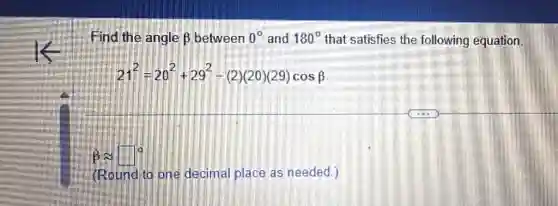
Find the angle beta between 0^circ and 180^circ that satisfies the following equation. 21^2=20^2+29^2-(2)(20)(29)cosbeta beta approx square ^circ (Round to one decimal place as needed.)
Solution4.4(186 votes)
Answer
Explanation
Similar Questions
1 Fill in the Hank 3points Ahistogram can give you the $\square $ the data, the choose your answer. of the data. choose your answer. $\square $ and the $\square $ v choose your answer- choose your answer... end The barsor intervals in a histor shape and represent the data. 2
Apply the distributive property to the expression. $100(0.07a+0.02b)=\square $
51. Find the volume of a pyramid with a square base, where the perimeter of the base is 15.8 ft and the height of the pyramid is 20.4 ft. Round your answer to the nearest tenth of a cubic foot.
4) $v^{1}=$ A) 0 B) 1 OC) v OD) $1/v$
What is the range of the function graphed above? $-\infty \lt y\leqslant 2$ $-\frac {3}{2}\leqslant y\lt \infty $ $-\infty \lt y\lt \infty $ $\{ 2\} $
2. You are inscribing a regular pentagon in a cIrcle. You need to know the angle measure between the vertices. You divide $360^{\circ }$ by what number? 3 s 6
Which equation represents a line that has a slope of $-\frac {1}{2}$ and passes through point $(4,-5)$ $y=-\frac {1}{2}x+\frac {3}{2}$ $y=-\frac {1}{2}x+\frac {13}{2}$ $y=-\frac {1}{2}x-7$ $y=-\frac {1}{2}x-3$
Smartphones: A poll agency reports that $38\% $ of teenagers aged $12-17$ own smartphones. A random sample of 120 teenagers is drawn. Round your answers to at least four decimal places as needed Part: 0/6 Part 1 of 6 (a) Find the mean $\mu _{\hat {p}}$ The mean $\mu _{\hat {p}}$ is 45.6000 Part: 1/6 Part 2 of 6 (b) Find the standard deviation $\sigma _{\hat {p}}$ The standard deviation $\sigma _{\hat {p}}$ is $\square $
1. If $x+3=7$ then x equals: A. 3 B. 4 C. 5 D. 10
Solve the equation given by completing the square. $5x^{2}+20x-25=0$ [Hint: Divide by 5 first] $x=\square $