


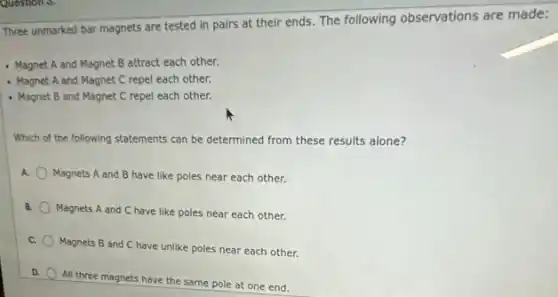
Question 3. Three unmarked bar magnets are tested in pairs at their ends. The following observations are made: - Magnet A and Magnet B attract each other. - Magnet A and Magnet C repel each other. - Magnet B and Magnet C repel each other. Which of the following statements can be determined from these results alone? A. Magnets A and B have like poles near each other. B. Magnets A and C have like poles near each other. C. Magnets B and C have unlike poles near each other. D. All three magnets have the same pole at one end.
Solution4.1(217 votes)
Answer
Explanation
Similar Questions
A 10 g gold coin is heated from $25^{\circ }C$ to $50^{\circ }C(C_{Au}is0.13J/g-^{\circ }C)$ What is the $\Delta H'$ $-32.5J$ $-25J$ $+25J$ $+32.5J$
Convert 810 mmHg to kPa. 6.16E5 kPa 760 kPa 1.14 kPa 107.9 kPa
Which one is Newton's second law of motion? The acceleration of an object as produced by a net force is directly proportional to the magnitude of the net force, in the same direction as the net force, and inversely proportional to the mass of the object. The acceleration of an object as produced by a net force is inversely proportional to the magnitude of the net force, in the same direction as the net force, and directly proportional to the mass of the object. $F=\frac {m}{a}(\frac {m}{s^{2}})$ $F=\frac {a}{m}(N)$
What is the best estimale of the mass of a cupcoke? A 80 pounds 80 grams C 80 tons kiloaroms
Describe how voltage, current and resistance behave in a parallel circuit. Edit View Insert Format Tools Table $\square $
A lead ball has a mass of 55 .0 grams and a density of $11.4g/cm^{3}$ What is the volume of the ball? 4.82 mL 0.207 L 4.82 L 0.207 mL none of the above
black holes? Gravity Normal Friction Applied What do we call the center of a black hole? Accretion Disc Event Horizon Singularity Black Point What force of physics causes nebulas to turn into stars, and later stars into 1 point 1 point
How was viscosity measured in the "Viscosity" lab? directly with a spring scale directly with a viscosity meter indirectly by measuring the distance a liquid flowed in a given time indirectly by measuring the volume of honey
You're driving down a highway late one night at $20m/s$ when a deer steps onto the road 35 m in front of you. Your reaction time before stepping on the breaks is 0.50 s, and the maximum deceleration of your car is $10m/s^{2}$ How much distance is between you and the deer when you come to a stop? 10 m Om 5.0 m 35 m 30 m
Match the items. a. Disturbance moves perpendicular to the direction of the wave b. Ocean Wave c. Sound d. Light e. Disturbance moves in the same direction as the wave 1. Surface Wave 2. Mechanical Wave 3. Electromagnetic Wave 4. Longitudinal Wave 5. Transverse Wave