


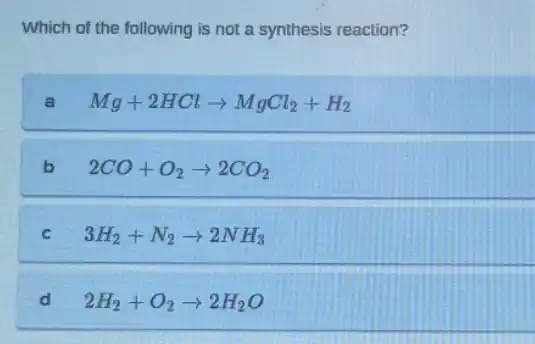
Which of the following is not a synthesis reaction? a Mg+2HClarrow MgCl_(2)+H_(2) b 2CO+O_(2)arrow 2CO_(2) C 3H_(2)+N_(2)arrow 2NH_(3) d 2H_(2)+O_(2)arrow 2H_(2)O
Solution4.3(242 votes)
Answer
Explanation
Similar Questions
13. Given the reaction: $Mg+2HCl\rightarrow MgCl_{2}+H_{2}$ What is the total number of grams of Mg consumed when 0.5mole of H2 is produced? 6.09 12g 3.0g 24g
10. Salt dissolved in water is classified as a: Pure substance Heterogeneous mixture Homogeneous mixture Compound
3. If 0.60 moles of iron sulfide react with 1.20 moles of oxygen, which is the limiting reactant? $4FeS+9O_{2}\rightarrow 2Fe_{2}O_{3}+4SO_{3}$
2. What is the gram-molecular mass of the compound with the formula $CH_{3}COOH$ 22.4g 44.09 48.09 60.09
1. What is the mass of 1.00 mole of f 02 gas? $O_{2}$
6. What trend in atomic radius occurs across a period on the periodic table? What causes this trend?
What is the charge of an iron atom with 24 electrons? $-2$ $+24$ $-24$ $+2$
Which example is an exothermic reaction? melting ice condensation dissolving ammonium nitrate in water to cool the water dissolving sugar in water
19. How many milliliters of isopropyl alcohol would you use to prepare 870mL of a $20\% (v/v)$ solution of isopropy alcohol?
6. Given the reaction: $Ca+2H_{2}O\rightarrow Ca(OH)_{2}+H_{2}$ How many moles of $H_{2}O$ are needed to exactly react with 2.0 moles of Ca? 1.0 mol 20 mol 0.5 mol 4.0 mol