
QuestionApril 15, 2026

3NH_(4)NO_(3)+Na_(3)PO_(4)arrow (NH_(4))_(3)PO_(4)+3NaNO_(3) 1. You have 30 grams of ammonium nitrate and 50.0 grams of sodium phosphate, What is the limiting reactant? 2. What is the excess reactant? 3. What is the maximum amount of each product produced?
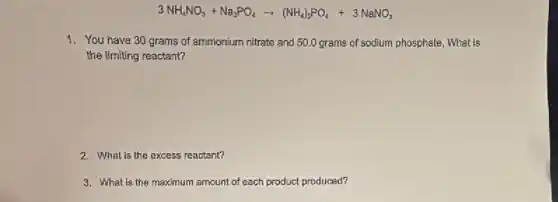
3NH_(4)NO_(3)+Na_(3)PO_(4)arrow (NH_(4))_(3)PO_(4)+3NaNO_(3) 1. You have 30 grams of ammonium nitrate and 50.0 grams of sodium phosphate, What is the limiting reactant? 2. What is the excess reactant? 3. What is the maximum amount of each product produced?
3NH_(4)NO_(3)+Na_(3)PO_(4)arrow (NH_(4))_(3)PO_(4)+3NaNO_(3)
1. You have 30 grams of ammonium nitrate and 50.0 grams of sodium phosphate, What is
the limiting reactant?
2. What is the excess reactant?
3. What is the maximum amount of each product produced?

Solution
4.1(237 votes)

Answer

Limiting reactant: NH_4NO_3 ### Excess reactant: Na_3PO_4 ### Max (NH_4)_3PO_4: 18.57\ \text{g} ### Max NaNO_3: 31.79\ \text{g} Explanation 1. Calculate molar masses NH_4NO_3: 14.01\times 2 + 1.008\times 4 + 16\times 3 = 80.05\ \text{g/mol} Na_3PO_4: 22.99\times 3 + 30.97 + 16\times 4 = 163.94\ \text{g/mol} 2. Convert masses to moles n(NH_4NO_3) = \frac{30.0}{80.05} \approx 0.374\ \text{mol} n(Na_3PO_4) = \frac{50.0}{163.94} \approx 0.305\ \text{mol} 3. Compare mole ratio with reaction stoichiometry Reaction ratio: 3 NH_4NO_3 : 1 Na_3PO_4 Required NH_4NO_3 for 0.305\ \text{mol Na_3PO_4}: 0.305 \times 3 = 0.915\ \text{mol} Actual NH_4NO_3 available: 0.374\ \text{mol} → less than required → limiting reactant is NH_4NO_3. 4. Determine excess reactant Na_3PO_4 is excess, since NH_4NO_3 limits reaction. 5. Calculate product moles from limiting reactant From 3 mol NH_4NO_3 → 1 mol (NH_4)_3PO_4 and 3 mol NaNO_3 n((NH_4)_3PO_4) = 0.374 \times \frac{1}{3} \approx 0.1247\ \text{mol} n(NaNO_3) = 0.374 \times \frac{3}{3} \approx 0.374\ \text{mol} 6. Convert product moles to mass (NH_4)_3PO_4 molar mass: 14.01\times 3 + 1.008\times 12 + 30.97 + 16\times 4 = 149.09\ \text{g/mol} Mass (NH_4)_3PO_4 = 0.1247\times 149.09 \approx 18.57\ \text{g} NaNO_3 molar mass: 22.99 + 14.01 + 16\times 3 = 84.99\ \text{g/mol} Mass NaNO_3 = 0.374\times 84.99 \approx 31.79\ \text{g}

Explanation

1. Calculate molar masses <br /> $NH_4NO_3$: $14.01\times 2 + 1.008\times 4 + 16\times 3 = 80.05\ \text{g/mol}$ <br /> $Na_3PO_4$: $22.99\times 3 + 30.97 + 16\times 4 = 163.94\ \text{g/mol}$ <br /><br />2. Convert masses to moles <br /> $n(NH_4NO_3) = \frac{30.0}{80.05} \approx 0.374\ \text{mol}$ <br /> $n(Na_3PO_4) = \frac{50.0}{163.94} \approx 0.305\ \text{mol}$ <br /><br />3. Compare mole ratio with reaction stoichiometry <br /> Reaction ratio: $3 NH_4NO_3 : 1 Na_3PO_4$ <br /> Required $NH_4NO_3$ for $0.305\ \text{mol Na_3PO_4}$: $0.305 \times 3 = 0.915\ \text{mol}$ <br /> Actual $NH_4NO_3$ available: $0.374\ \text{mol}$ → less than required → limiting reactant is $NH_4NO_3$.<br /><br />4. Determine excess reactant <br /> $Na_3PO_4$ is excess, since $NH_4NO_3$ limits reaction.<br /><br />5. Calculate product moles from limiting reactant <br /> From $3$ mol $NH_4NO_3$ → $1$ mol $(NH_4)_3PO_4$ and $3$ mol $NaNO_3$ <br /> $n((NH_4)_3PO_4) = 0.374 \times \frac{1}{3} \approx 0.1247\ \text{mol}$ <br /> $n(NaNO_3) = 0.374 \times \frac{3}{3} \approx 0.374\ \text{mol}$ <br /><br />6. Convert product moles to mass <br /> $(NH_4)_3PO_4$ molar mass: $14.01\times 3 + 1.008\times 12 + 30.97 + 16\times 4 = 149.09\ \text{g/mol}$ <br />Mass $(NH_4)_3PO_4$ = $0.1247\times 149.09 \approx 18.57\ \text{g}$ <br /> $NaNO_3$ molar mass: $22.99 + 14.01 + 16\times 3 = 84.99\ \text{g/mol}$ <br />Mass $NaNO_3$ = $0.374\times 84.99 \approx 31.79\ \text{g}$
Click to rate: