


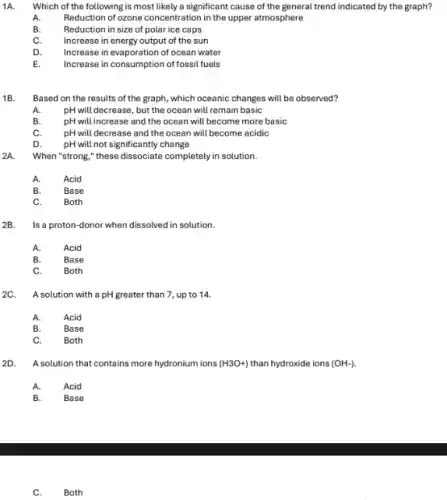
1A. Which of the following is most likely a significant cause of the general trend indicated by the graph? A. Reduction of ozone concentration in the upper atmosphere B. Reduction in size of polar ice caps C. Increase in energy output of the sun D. Increase in evaporation of ocean water E. Increase in consumption of fossil fuels 1B. Based on the results of the graph, which oceanic changes will be observed? A. pH will decrease, but the ocean will remain basic B. pH will increase and the ocean will become more basic C. pH will decrease and the ocean will become acidic D. pH will not significantly change 2A. When "strong," these dissociate completely in solution. A. Acid B. Base C. Both 2B. Is a proton-donor when dissolved in solution. A. Acid B. Base C. Both 2C. A solution with a pH greater than 7, up to 14. A. Acid B. Base C. Both 2D. A solution that contains more hydronium ions (H3O+) than hydroxide ions (OH-). A. Acid B. Base C. Both
Solution4.4(324 votes)
Answer
Explanation
Similar Questions
on Determine the number of valence electrons (i.e ., outer shell electrons)in $CCl_{4}$
Calculate the 'percent by mass of SALT in a solution made by mixing 4.00 grams of salt into 98 grams of water (always be mindful of significant figures)
1. Explain what group/column Helium and Beryllium each can be found in on the Periodic Table. Determine which features Helium has in common with features in the vertical group including Beryllium. Use evidence from Data Table 1 to support your answer. Write your Answer here
C. Full Screen Select the correct answers from the drop down menus based on this chemical reaction: $NH_{3}+H_{2}O\longleftrightarrow NH_{4}^{+}+OH^{-}$ The conjugate $\square $ of $NH_{3}$ is $\square $ while the conjugate $\square $ of $H_{2}O$ is $\square $ (A) Accessibility
Classify each of the following as acidic, basic,or neutral. Drop Zones 6 Reset All Acidic (V3) Neutral (2/3) Basic (3/3) $\square $ Pure water $\square $
pounds himary honic compounds. 1. Allin a. $BaCl_{2}$ 3. $MgI_{2}$ 4. $Ca_{1}P_{2}$ 5. KP Part 2 Write the chemical formula for the following binary tonic compounds. 6. Aluminum sulfide 7. Lithium chloride 8. Calcium iodide 9. Sodium nitride 10. Magnesium oxide Challenge: See if you can draw the Lewis structures for each compound! Chemical Bande Unit
Critical Thinking Questions (Yes, we did some of this $1^{st}$ semestern 10. What type of force exists between two $F_{2}$ molecules-dispersion,, dipolar,or hydrogen bonds? 11. What type of force exists between two $Cl_{2}$ molecules-dispersion,dipolar,or hydrogen bonds? 12. Recall the trend in sizes as one proceeds down a column of the periodic table. Do atoms get larger or smaller? Rank the sizes of fluorine, chlorine bromine, and iodine in order from smallest to largest. Smallest 1. __ __ .3. __ 4. __ Largest 13. The forces between chlorine molecules cause them to be a gas at room temperature. The forces between bromine molecules cause them to be liquid at room temperature. a. Do chlorine or do bromine molecules have stronger forces of attraction between them? Why? __ b. True or False:If two different kinds of molecules have dispersion forces, then the dispersion forces are equal in strength. __ 14. Considering your answers to questions 2 and 3, complete the following: The larger the molecules are,the __ the intermolecular forces are between them. 15. The states of the substances are given in the table above . Which kind of substance have the strongest intermolecular forces: solids, liquids, or gases? __ 16. In general,are lighter molecules more likely to be gases or solids? __ 17. Propane's formula is $C_{3}H_{8}$ and octane's formula is $C_{8}H_{18}$ Propane is a gas at room temperature, but octane is a liquid. a. Which molecule has the strongest intermolecutar forces: propane or octane? b. Would you expect $C_{2}H_{6}$ to be a solid,liquid or a gas at room temperature? 18. Consider two substances-one that has dipolar intermolecular forces and one that has London dispersion forces. a. Which has the strongest intermolecular forces? b. Which is most likely to be a gas at room temperature?
Avogadro's law and Charles'law describe a proportionality of the volume of a gas when the pressure is constant. Which describes the proportionality that allows these laws to be combined when describing a gas? Volume is directly proportional to temperature (Avogadro's law) and to moles (Charles's law) Volume is inversely proportional to temperature (Avogadro's law) and to moles (Charles's law) Volume is directly proportional to moles (Avogadro's law)and to temperature (Charles's law) Volume is inversely proportional to moles (Avogadro's law) and to temperature (Charles's law)
The data in Table 2 indicates that as the concentration of carbon dioxide in the water rises: A. the pH decreases and the balance shifts toward bicarbonate instead of carbonate. B. the pH increases and the carbonate ion concentration increases. C. both the pH and the bicarbonate concentration decrease. D. the pH increases and the balance shifts toward carbonate instead of bicarbonate.
A lithium ion $(Li^{+})$ is in its ground state. How many electrons are in a neutral lithium atom? $\square $ How many electrons are in a lithium ion $(Li^{+})$ $\square $ Complete the ground-state electron configuration of a lithium ion $(Li^{+})$ using noble gas notation. $\square $ $\square $ $\square $